
World Models' Transformative Role in Gaming
What does accelerating investments into world model companies mean for the gaming industry?
Hi everyone!
This week, we dive into the emerging category of world models and explore the impact they could have on the gaming ecosystem. For additional context, we highly recommend our recent interview with General Intuition’s CEO, where he discusses the potential of world models.
Additionally, our partner Sensor Tower just released its State of AI 2026 Report. Go check it out!
Sponsor: How Agentic AI Drives Efficiency in Game Development

Industry leaders from Xbox, Sega, PlayStation Studios, and EPAM recently gathered to examine what happens when AI stops following scripts and starts shaping experiences. The conversation covered autonomous NPCs, adaptive world-building, AI safety, and the critical role that human creativity still plays when technology handles repetitive work.
Key themes explored:
From copilot to agent. AI has evolved from code-assist tools to end-to-end agentic systems capable of autonomously delivering entire features.
Creativity amplified, not replaced. AI accelerates prototyping, but taste and craft remain irreplaceable — tools alone never reach a creator’s standard.
Living, infinite worlds. Games can now adapt in real time to a player’s personality, mood, and history — moving from static narratives toward endlessly evolving content.
Safety first. Player-facing generative AI must be load-tested like live services; poor personalization is “toxic to the experience.”
New genres emerging. AI-native games and text-based formats are making a comeback, giving players deeper agency.
Read the full report here: Agentic AI in Gaming: Evolving Game Development and Player Experiences | EPAM
World Models' Transformative Role in Gaming
Written by Francois Courset, Lead Consultant at Naavik

World models have emerged as one of the most engaging technology narratives both within and beyond gaming. From Google Project Genie’s preview triggering a shockwave across gaming stocks in February 2026 to a recent wave of high-profile announcements — including Roblox’s acquisition of Morpheus AI, Tencent’s release of HY-World 2.0, AMI Labs’ $1B raise, and Tripo AI’s $200M funding round — it is easy to feel overwhelmed.
Now is a good time to take a step back and synthesize all the action and noise. Why are we witnessing accelerating investments into world model companies? What disruptions may the gaming industry face? And what role will gaming companies play in shaping the burgeoning world model ecosystem, which touches far more than gaming itself?
What Are World Models?
World models are AI systems that learn from video, simulations, and other spatial data to build internal representations of scenes and objects, enabling them to predict how an environment evolves and how an agent’s actions change it. Given a current state and an action, they can predict the next state in a way that stays consistent with the rules of the world they learned from. It’s all about modeling action-induced cause and effect. They differ from video models (Sora, Veo, etc.) that produce plausible footage from a prompt without a structured action input.
For a more detailed introduction, we recommend looking at Naavik’s deep dive on world models, Not Boring’s in-depth essay, and MoE capital’s overview which we’ll refer to throughout this article.
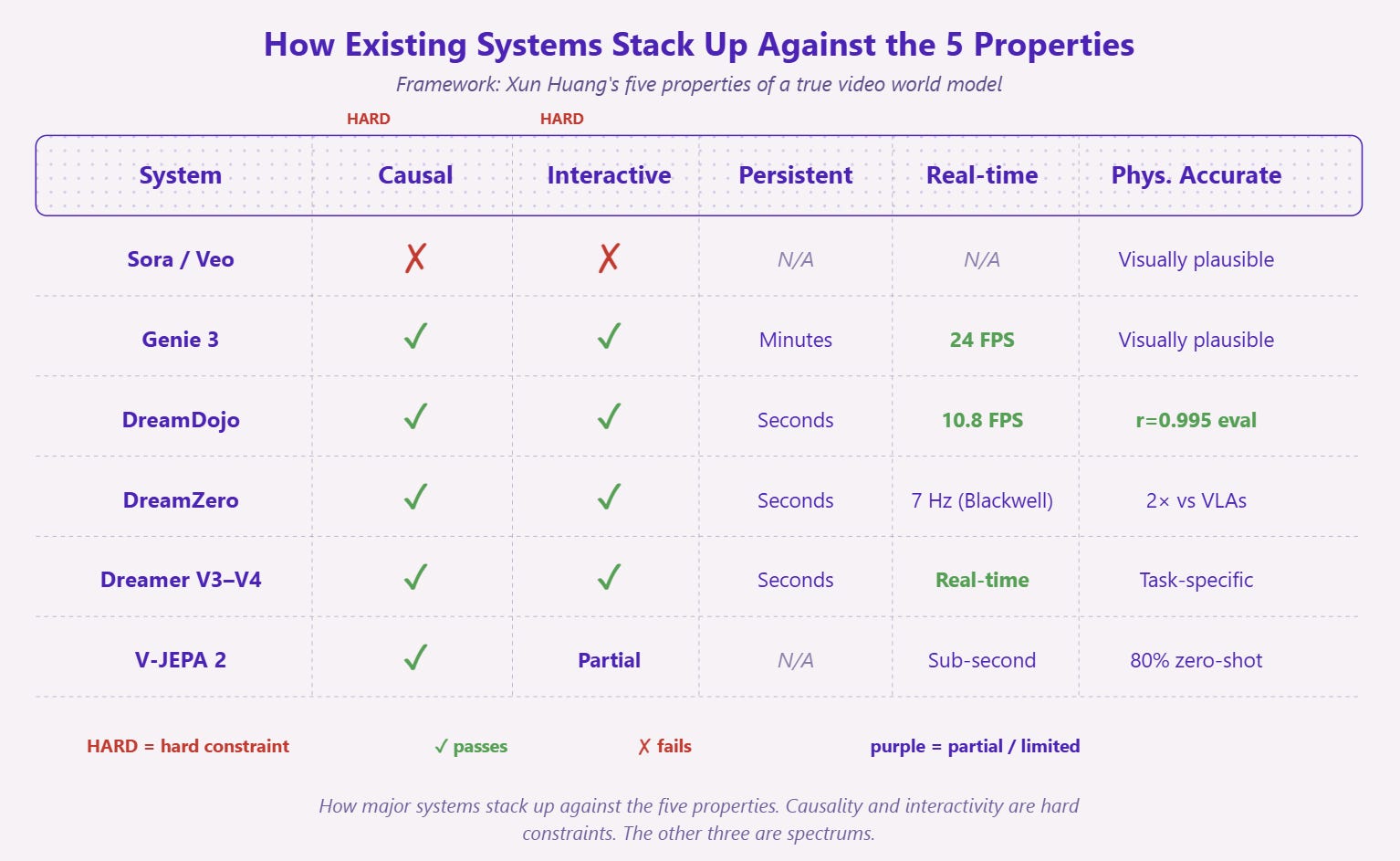
Not all world models are created equal. Xun Huang, CEO of Morpheus AI (recently acquired by Roblox), argues that five properties separate world models from traditional video models: causality, interactivity, persistence, real-time responsiveness, and physical accuracy. Models such as Genie 3, DreamDojo, and DreamZero each make different tradeoffs across these dimensions.
World models are a recent breakthrough, because they finally merge two research traditions that each had half the solution. One tradition built AI that “dreams” — learning a model of the world and practicing actions inside its own imagination — but these couldn’t generalize or produce realistic visuals. The other learned from massive amounts of internet video to generate photorealistic, physics-obeying footage (like Sora) but wasn’t interactive; you couldn’t feed it an action mid-stream. Between 2024 and 2026, advances made video generation fast and action-responsive enough to combine both, producing simulators that are realistic and interactive.
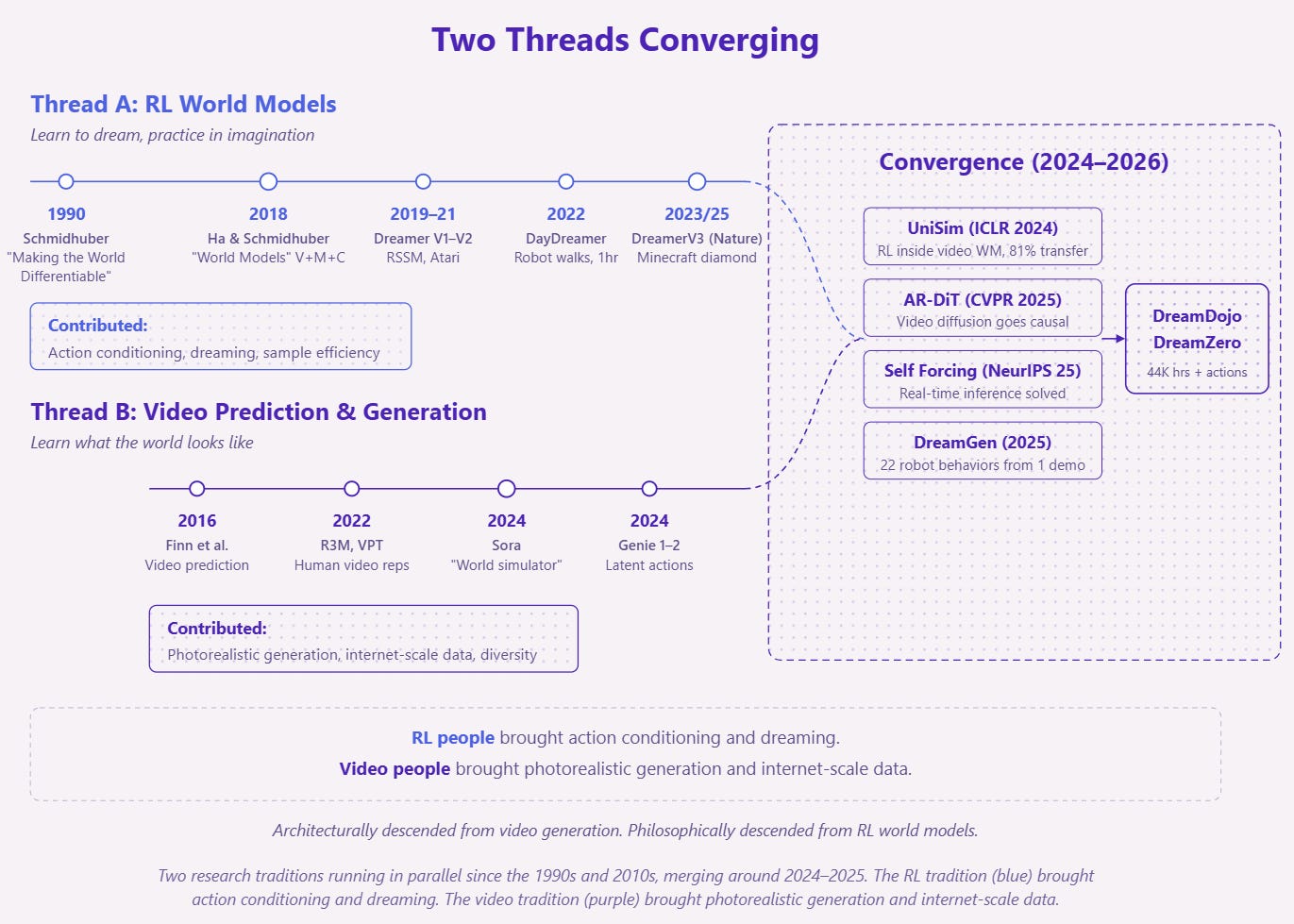
This ultimately led to the first generation of world models that provided a glimpse at the technology’s potential, culminating with Google Genie’s preview in early 2026 (see Naavik’s dedicated breakdown).

The potential of world models spans far beyond gaming. While world models use gaming videos as training data and grounded their earliest demos in gaming worlds (like Decart’s Oasis with Minecraft or GameNGen with Doom), the technology’s potential spans multiple industries. Key application areas include robotics, autonomous vehicles, military, training and simulation, architecture, entertainment, and, of course, gaming. It’s key to note that the potential in other areas — like robotics — is likely far larger than gaming. To address this breadth of use cases, different groups of world models are emerging:
Renderers: models that take in actions and output visually realistic pixel observations for humans, focusing on appearance rather than true 3D structure or accurate physics.
Simulators: models that output underlying world state (geometry, physics, dynamics) so both humans and programs can reliably inspect, compute on, and interact with a structurally accurate environment.
Planners: models that take observations and goals as input and output sequences of actions, deciding what an agent should do next and thus closing the perception–action loop.
World Models’ Takeoff Phase
The past six months have marked an acceleration in investment and announcements tied to the world model ecosystem, pushing the category into one of the most aggressively funded frontiers in technology. More than $10 billion has flowed into the category over the past 18 months, including funding rounds such as AMI Labs at $1.03B, World Labs at $1.23B, Runway north of $860M, Rhoda at $450M, and Decart at $153M, and likely more to come very soon.
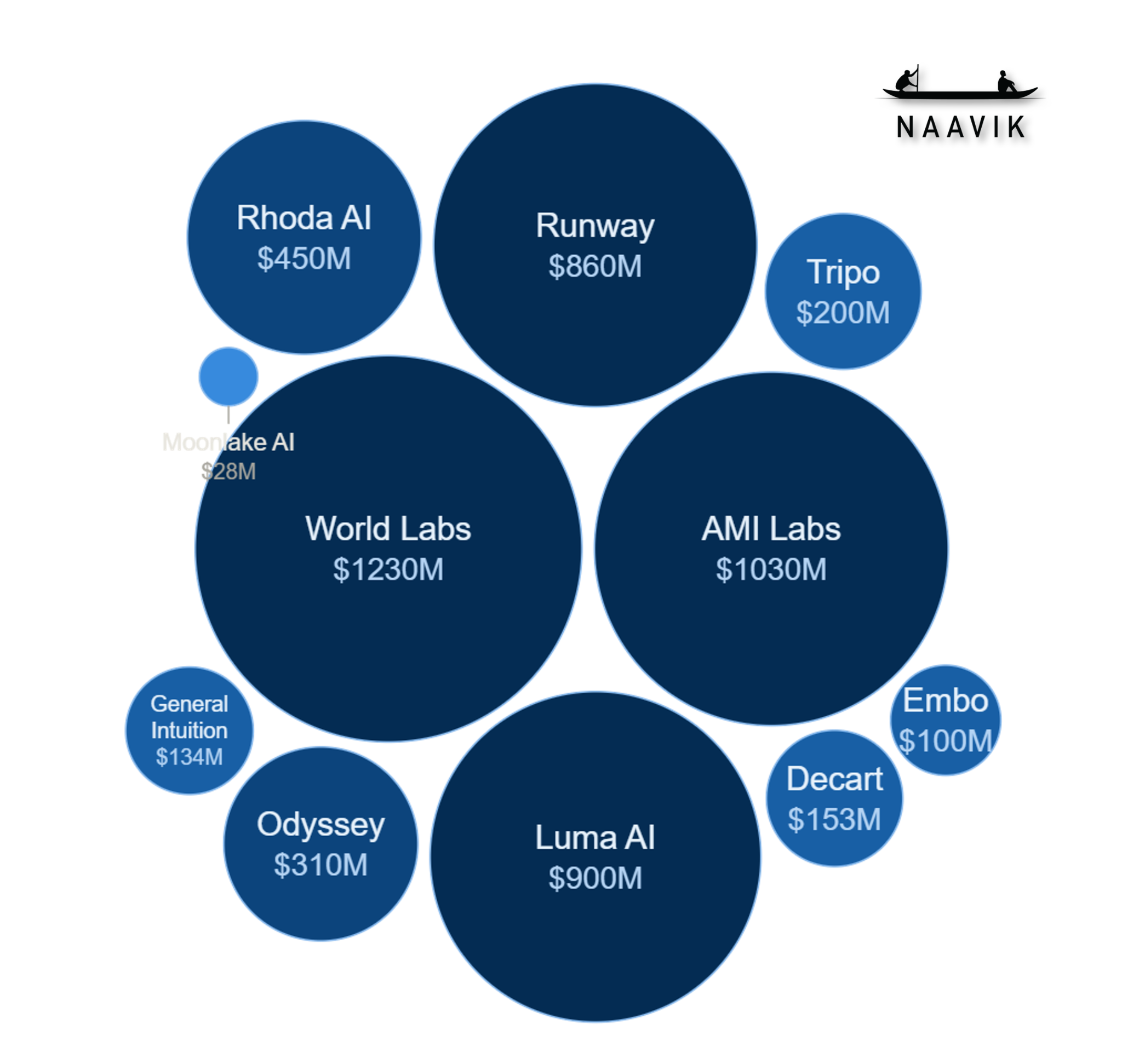
Gaming companies are piling into the world model race, too. General Intuition raised $134M built atop Medal’s vast library of gameplay clips, 3D asset generation startup Tripo pulled in $200M to push its own world model ambitions, Roblox stood up a new Roblox Reality division by acquiring Morpheus AI, and Krafton stretched its AI bets all the way into robotics and military simulation.
Taken together, these point toward the opening act of a hype cycle reminiscent of the LLM surge that detonated in late 2022. Capabilities are improving rapidly, unlocking new use cases and accelerating adoption.
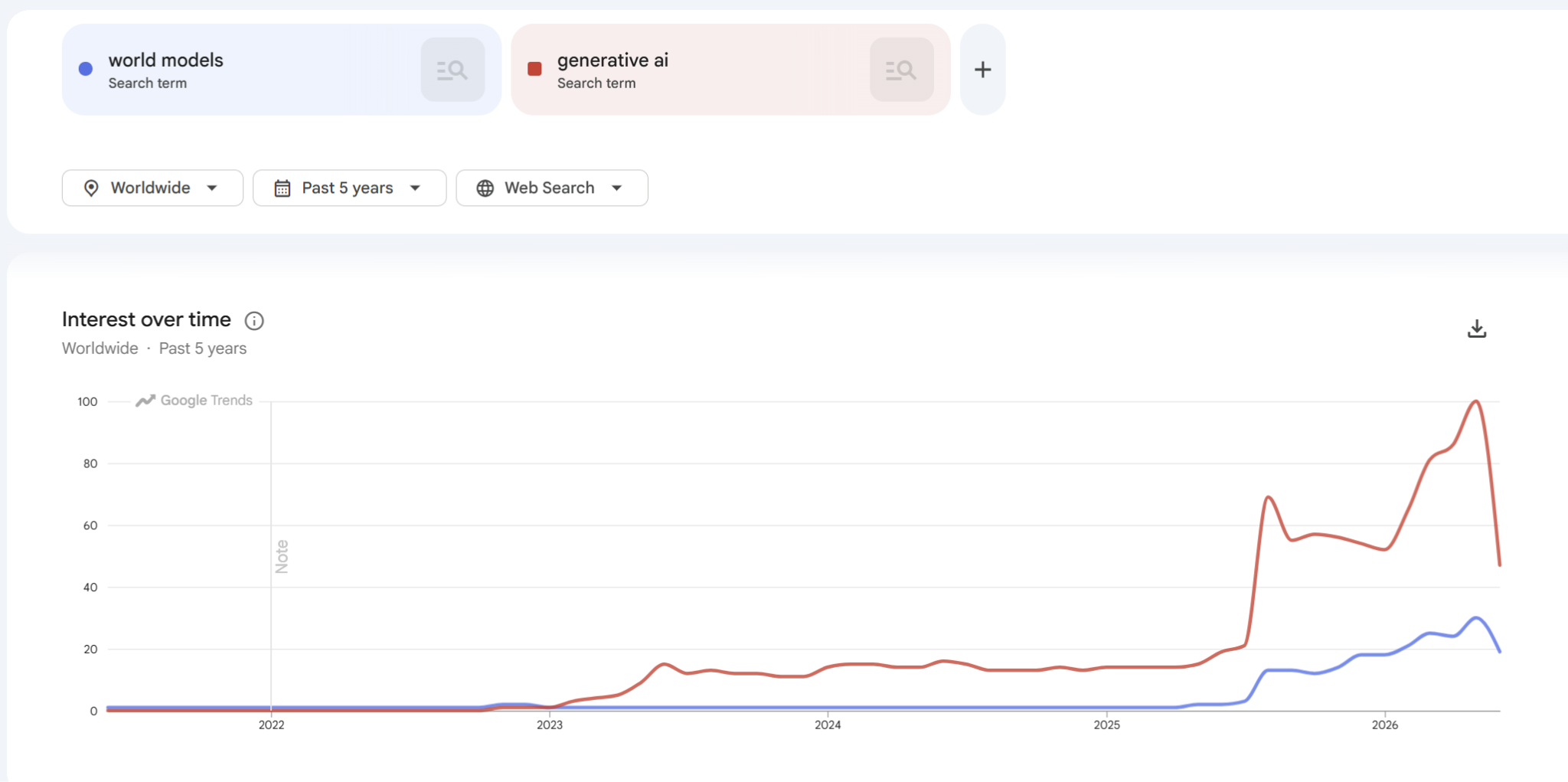
This is precisely where gaming professionals need to grasp the full scope and ambition of world models: those $100M+ seed rounds and billion-dollar valuations simply can't be justified by gaming applications alone. To justify these valuations, companies will likely need to reshape larger industries such as robotics or help create entirely new forms of interactive experiences.
From Frontier Labs to Structured Ecosystem
Before diving into gaming specifics, let’s figure out what’s actually happening behind all of the headlines.
First is recognizing that world models have moved past the pure-research phase, with the first commercially-ready, open-source models — Nvidia’s DreamDojo and Tencent’s HY-World 2.0 — now widely available. This pushes AI labs to differentiate less on whether the tech works and more on inference economics and on acquiring quality training that sets their models apart.
Next is specialization. From narrowing focus to one of three model categories (Renderers, Simulators, or Planners), to building specialized models trained on domain-specific data sets. The next generation of models will move beyond proof-of-concept demonstrations and become increasingly optimized for specific use cases such as generating scenes and supporting actions in 3D spaces.
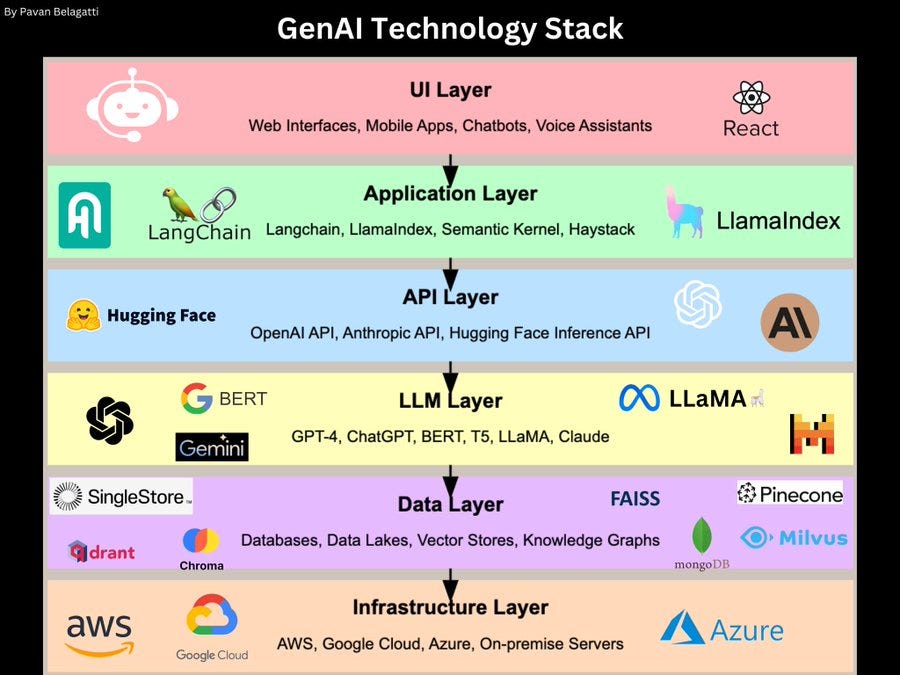
Lastly, and perhaps most importantly, world model initiatives are expanding beyond foundational models and are shaping a comprehensive stack. Stable-worldmodel provides a unified, modular framework for the entire pipeline of world model development: data collection, training, and evaluation. Reactor World positions itself as an infrastructure layer for the “World Model era,” where every major world model is available on one API. As happened with the LLM ecosystem, new entrants are likely to emerge across every layer of the value chain, from consumer-facing applications to the infrastructure and hardware layers. What we’ve seen across the first half of the year is the emergence of the first contenders in this emerging “world models stack.”
What’s Next for Gaming Companies
Arms race for talent at the intersection of 3D and AI
If world models are the next frontier in AI, the people best equipped to build them may already be sitting in game studios. World-model researchers occupy one of the thinnest slices of an already supply-constrained AI talent market, and gaming professionals have spent decades solving exactly the kinds of problems these systems require: physics, 3D environments, and interaction dynamics within simulated worlds.
It is no coincidence to see acqui-hire announcements in and around gaming startups, from the founders of Morpheus AI, Dynamics Lab, Lucid AI jointly joining Roblox, to Google Deepmind acquiring three startups at once, including 3D asset-generation startup Common Sense Machine.
While these acquisitions offer healthy exit opportunities for startups still wrestling with product-market fit, they also nudge gametech founders away from the problems that genuinely matter to our industry, such as pipeline-ready asset generation. This creates a paradoxical innovation squeeze, as key technical talent gets redirected toward larger non-gaming opportunities with deeper pockets.
Recognizing the value of gaming’s data
A world model learns the dynamics of an environment. It takes in observations — usually video frames — builds a compressed internal representation of the world’s state, and predicts how that state will change in response to an action. The key ingredient is the causal link between action and consequence, which can’t easily be scraped from the web. Gaming, it turns out, is sitting on the richest supply of exactly that through gameplay videos or engine-level capture.
Companies able to systematically gather and label gameplay data are bound to play a key role in world models’ future development. That’s the thesis behind General Intuition, which leverages Medal’s library of roughly two billion clips a year from around ten million monthly users across tens of thousands of games. The same goes for Microsoft and Minecraft’s years of first-party gameplay telemetry, Amazon with Twitch, or Google with YouTube’s data. Roblox could also play a significant role in world model development, because it possesses the world’s largest multimodal 3D dataset of proprietary user interaction data, paired with millions of 3D object assets and even user-generated clips.
More importantly, it reframes data from a supporting asset into a core value driver for gaming companies. Origin Lab, which provides a marketplace for capturing, creating, and delivering premium, rights-cleared multimodal content for AI training, could be a key enabler for companies to better monetize their proprietary datasets.

The pipeline efficiency perspective
The most immediate application of world models in gaming will be at the front of the pipeline, where they enhance ideation and compress prototyping cycles. By drafting environments, scenes, and dynamic storyboards on demand, teams can iterate on atmosphere, pacing, and composition long before committing to full asset development.
The next unlock sits further downstream in level and world design, as models generate persistent, editable 3D worlds from text, images, videos, or panoramas and export them in standard game-engine formats — a use case World Labs is actively chasing with its Marble product.
The longer-horizon and more bullish case is Roblox’s approach, applying world models inside UGC ecosystems to deliver photorealistic output without manual high-fidelity asset creation. That would meaningfully lower the barrier to entry, expand Roblox’s reach, and let it compete more directly with traditional AAA experiences.
Consumer-facing innovation is still far on the horizon
We have already shared our doubts on the game engine-killer vision for world models when Project Genie was first shown, simply due to games being defined by stable, repeatable rules and deterministic outcomes. Rather, perhaps there is potential in a hybrid entertainment experience somewhere between games and videos. There are reasons to believe this prospect remains far on the horizon.
Nearly four years into the generative AI wave, we’re only now seeing the first iterations of AI that deliver meaningful, genuinely fun value to the player experience — and world model–based innovation is likely to follow a similarly long experimentation phase. That timeline is compounded by the need to craft entirely new interfaces for engaging with world-model experiences, a challenge the VR ecosystem knows well. Cost is another constraint: today’s world model inference runs an order of magnitude higher than comparable workloads, with Genie 3 estimated at roughly $100 per hour, and while foundational model iteration should bring that down, solving the cost equation will remain central to any consumer-facing application. Finally there’s the question of demand. A new kind of experience may be technically possible, but VR is a cautionary tale that content innovation doesn’t automatically translate into consumer pull, let alone market share against traditional gaming.
The billion-dollar rounds aren’t being underwritten by gaming, but gaming data still has the potential to help catalyze the transformation of other industries. Gaming is historically at the tip of the technological spear (3D graphics, online interactivity, etc.), and its uses often set the foundation for progress elsewhere in the world. World models are no different. Although the future is fuzzy in terms of how world models may transform entertainment experiences, progress elsewhere looks undeniable and exciting. Of course, we’re incredibly early in the journey of world models and are excited to track its progress, inside and outside of gaming, over time.
Top News Items
Written by Devin Becker, Consultant at Naavik
Krafton Launches Beta for AI Ally in New PUBG Arcade Mode
Krafton opened a beta test for Ally Duo, an arcade mode in PUBG: Battlegrounds where players team up with Ella, an AI companion powered by Krafton’s PUBG Ally technology. Built on NVIDIA ACE and running an on-device small language model, Ella responds to voice commands, understands in-game situations, and adapts her behavior in real time, covering movement, item collection, and combat strategy. Unlike traditional bot teammates that follow fixed scripts, Ella processes voice input alongside the evolving match state to act more like a reactive human partner. Krafton first announced the PUBG Ally concept in October 2025, but implementation took significantly longer than expected.
The extended development timeline is worth noting because it underscores how difficult it is to ship AI companions that feel genuinely useful in a fast-paced, competitive environment. Battle royale matchmaking has long struggled with unreliable teammates, so a dependable AI partner could address a genuine player pain point. If Ella performs well enough, this could become a template for how live-service shooters help retain solo players who churn out of squad-based modes. Running on-device rather than in the cloud introduces potential hardware limitations, but it also helps keep costs manageable — an important consideration for a free-to-play game operating at PUBG's scale. See our previous coverage of Krafton’s AI strategy here.
Mobile Game Neural Dawn Showcases Arm's Latest AI and Graphics Technology
Arm and Sumo Digital unveiled Neural Dawn, a mobile game built to demonstrate Arm’s Neural Technology running on next-generation Arm-developed Mali GPUs. It is the first mobile game to use Unreal Engine MegaLights in real time, delivering ray-traced shadows, hundreds of dynamic lights per level, and cinematic-quality rendering within a mobile power budget. The key enabling tech is Arm’s neural accelerators built directly into the GPU, running Neural Super Sampling and Denoising (NSSD) and Neural Frame Rate Upscaling (NFRU) to offset the cost of advanced lighting. A team of just 17 people at Sumo Digital built the game in roughly 18 months using standard Unreal Engine workflows and Arm’s plug-in tools.
What matters here is more the proof point and less the game itself. Mobile has always been constrained by the tension between visual ambition and battery life, and Arm is demonstrating that neural graphics can potentially change that equation. If these capabilities ship at scale in consumer devices later this year as planned, they could materially raise the visual baseline for mobile games by bringing rendering techniques that remain uncommon even on consoles to a much broader audience. It remains to be seen what the install base will look like for those devices once shipped, and the games will still need fallback graphics. Regardless, game developers will no doubt showcase the games using this rendering tech.
Crystal Dynamics Uses Generative AI for Early Prototyping, but "Finished Content Is Human-Created"
Crystal Dynamics addressed growing backlash over the AI disclosure on the Steam page for Tomb Raider: Legacy of Atlantis. Experience director Jeff Adams explained that the studio uses generative AI during early level design to quickly visualize candidate objects in a scene before committing developer time to building them. If the AI-generated visualization works, the asset moves into the traditional production pipeline where artists then build it from scratch. Adams stated that all finished content in the final game is human-crafted.
Crystal Dynamics is trying to thread a needle on transparency. The “AI for ideation, humans for shipping” framing is becoming the standard talking point, and it will likely become more common as Steam’s AI disclosure requirements force transparency. Usually this gets talked about when teams are caught “accidentally” shipping AI assets in the finished product. The real tension is whether players and communities will accept any level of AI involvement regardless of how the final product is made. With unnecessary backlash from gamers surrounding non-player-facing uses of AI, this is another example of why Steam’s forced disclosure may be doing more harm than good without much more narrow usage.
Welevel Unveils AI-Based City-Building Survival Game SolidRiver and $8.5M in Funding
Munich-based studio Welevel closed an $8.5 million funding round and revealed SolidRiver, a city-building survival game that uses AI to power smarter NPCs, dynamic gameplay, and developer productivity. Founder Christian Heimerl, a self-described hardcore MMO veteran, described the vision as creating a living world with AI serving as a real-time dungeon master. The AI handles tasks players find tedious (chopping 1,000 trees, for example) while also driving NPC behavior and world reactivity. Notably, Welevel is also building technology that could be licensed to other game studios.
The dual-purpose approach — building a game and a platform simultaneously — is becoming a pattern among AI-native studios due to the lack of ready-made solutions. Whether SolidRiver succeeds or not as a game, the underlying tech becomes a possible middleware play. This strategy reflects this particular phase of funding AI game development, similar to what we saw in web3 gaming a few years ago. Many investors are drawn to startups where the IP extends beyond a single title or acts as a launchpad for licensing tech to others. The $8.5M raise is modest by AAA standards but meaningful for an indie studio betting that AI-driven world simulation is a defensible competitive advantage.
NVIDIA RTX Updates Bring DLSS 4.5 to UE5 and Multilingual AI Characters
NVIDIA shipped a batch of RTX ecosystem updates aimed squarely at game developers. DLSS 4.5 is now available as an Unreal Engine plugin, delivering Dynamic Multi Frame Generation, a new 6x mode, and a second-generation transformer model for Super Resolution. Alongside the rendering upgrades, NVIDIA ACE expanded its multilingual AI character capabilities with three new models: Qwen 3.5 4B for low-latency dialogue across 201 languages, Riva Parakeet for speech recognition in 25 languages, and Chatterbox Multilingual for expressive voice synthesis in 24. All run locally on RTX hardware via the NVIGI SDK.
The practical significance is the convergence of rendering and AI character tech into a single, integrated toolchain. NVIDIA is making it increasingly frictionless for UE5 developers to ship both better-looking games and conversational NPCs without stitching together third-party solutions. The multilingual angle is especially notable as localization of AI-driven dialogue has been a major open question, and running it on-device sidesteps the latency and cost issues of cloud-based alternatives. Studios that adopt NVIDIA's stack early could gain a head start in shipping AI characters to global audiences, assuming it provides meaningful advantages over third-party tools that may already be more mature. The easier this process becomes, the more likely we’ll see games experimenting with the technology despite some current gamer backlash.
Other News Items
Sony AI Releases Woosh Foundation Model for Sound Effect Generation
Claude Code Game Studios turns a single Claude Code session into a “full game development studio”
Autodesk’s Neural CAD brings AI reasoning to design and engineering
Content Worth Consuming
Sensor Tower: State of AI 2026 Report (Sensor Tower): “The trend suggests that AI is becoming an increasingly effective discovery and user acquisition driver across app categories. As consumers actively seek AI-powered experiences, developers are gaining new opportunities to attract users by highlighting AI capabilities in app listings and marketing.”
Take-Two’s former head of AI shares his concerns on the current hype cycle (GamesIndustry.biz): “’It’s so contextual,’ he says. ‘If you’re a tiny startup and you are going out of business in six months, why wouldn’t you use every advantage available? If you want to genAI all the things, it’s important that you understand the ethical implications of that. It’s a really hard one to wrestle with. If you have to pay minimum wage to bring in an artist, it’s already been an accepted practice to bypass minimum wage in your region and outsource it to somewhere where there’s a cheaper cost of living and pay below minimum wage for the same output. In some ways, how is this different?’”
Arkadium launches GameLab to make AI ready for the real world (GamesBeat): ‘“I am having more fun now than I have in the last decade, and where most game developers are saying, ‘How do I use AI to make game production faster or cheaper, with my art or my coding?’ We’re flipping that whole thing on its head and saying, ‘How do we use games to make the models better, right?’” Rosenblatt said.’
The devs of Chinese hit The Scroll of Taiwu on what Western devs get wrong in China - and why they rejected generative AI (GamesIndustry.biz): “Qiezi clarifies that no AI was used in the development of The Scroll of Taiwu. ‘But I think AI can be used as a tool and people are allowed to try it,’ he says. ‘Not in game creation, but more in management work or as a tool to reduce the burden of communications. For a game, it needs to be unique and to be something that people didn’t think of before or couldn’t imagine before, so those kinds of artworks could not be produced by AI.’”
The future of Hollywood isn’t feeding prompts into vanilla gen AI models (The Verge): “Watching all of these films, I got the distinct sense that there is no future where studios are cranking out commercially viable projects by feeding prompts to gen AI models. That kind of content probably isn’t going to go away, but it’s not the kind of stuff Hollywood’s heavyweights would want to put their names on. What seems much more likely is bigger AI firms like Google partnering with studios to build bespoke models that are tailored to very specific workflows. And those workflows really only function well when they’re guided by human artists with very clear creative visions.”
More About Naavik
Naavik’s team of experts has helped over 300 companies — publishers, studios, tech companies, and investors — succeed across the video game industry. We’d love to work with you too! Here’s what we offer, spanning all platforms, genres, and regions:
Strategy Consulting: Projects covering market research, corporate strategy, game and economy design, gamification, live ops strategy, AI strategy, product management, brand and performance marketing, and more.
M&A and Investment Advisory: Expert commercial due diligence for buyers, fundraising support for sellers, and fractional CFO/CSO services.
Fractional Talent: The one-stop shop for top-tier fractional talent covering dozens of game industry roles — analytics, design, marketing, art, QA, and more.
Check out the links above for more details. If you’d like to chat about how Naavik can serve your team, click the box below or send us a note at consulting@naavik.co.