
Hi everyone, and welcome to another Mobile F2P newsletter!
Today, we look at specific match-3 level design lessons developers can learn, from the market's current experimentation with “innovative match-3 levels”.
In case you missed it, our last Weekly Digest explored whether licensed IP could improve commercial outcomes enough to justify the trade-offs. Our last AI x Gaming newsletter also looked into Roblox’s massive bet on AI-assisted creation. Check it out here.
Lastly, as always, if Naavik's services can support your business, please reach out. We'd love to chat.
Partner Spotlight: The UA elite in one closed room. You get the recordings.
In October, Sett is bringing together mobile gaming’s UA and creative leaders in Barcelona for three days: Supercell, Tripledot, SuperPlay, Homa Games, Madbox, Stillfront, Turborilla, Zynga, and more. No stage. No pitches. And the guest list is full.
These are the conversations people only have behind closed doors. Where AI actually helps your UA and where it wastes a quarter. How the top studios launch games now. How to spot a potential winner and the workflows behind it. Running a UA team when agents do the tasks. Where the edge lives when everyone has the same AI. What everyone is really doing with playables, backed by real data.
Register, and every recorded session will land in your inbox a few days after the event. Free.
Why “Innovative” Match-3 Levels is Not a USP
Written by Harshal Karvande, Principal Designer at Rovio
The casual match-3 puzzle market is notoriously saturated. Naturally, one of the key ingredients for breaking into this subgenre’s top-grossing charts has been to find a USP — or regularly refreshing it if you’re already an incumbent. One area where that search for differentiation has become especially visible is level design.
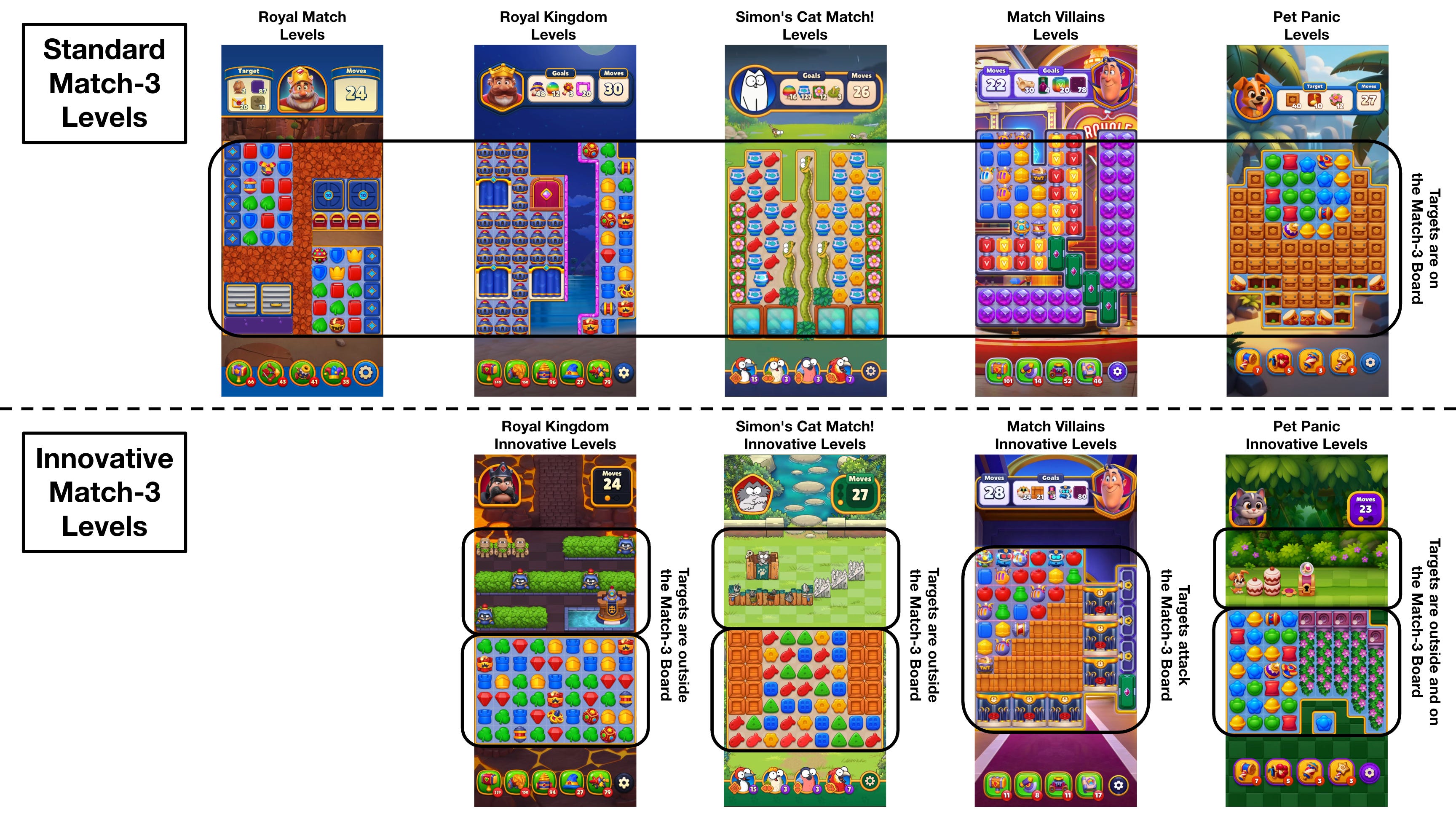
Since Dream Games’ 2023 soft launch of Royal Kingdom (RK), match-3 developers have increasingly tested a specific hypothesis: introducing alternative “innovative match-3 levels” into the mandatory level funnel will help strengthen the USP and drive stronger market performance. Key examples of games testing this hypothesis include RK’s Attack levels (from Dream Games), Match Villains’ (MV) Heist levels (from Good Job Games), Pet Panic’s Rescue levels (from Queen Digital Entertainment, an ex-King studio), and Simon’s Cat Battle levels (from Tactile Games) — all of which feel closer to a puzzle RPG experience.
While a match-3 title’s overall success relies on a wide array of ingredients, its level design USP is a very important factor because of the amount of a player’s session spent in level content. Unfortunately, none of the titles mentioned above are scaling successfully, which may be due in part to their level design USP choices. In this newsletter, we’ll look at the specific level design lessons developers can learn from the market’s current experimentation with “innovative match-3 levels” as a USP.
“Innovative Levels” Might Be Alienating Match-3’s Mass Market
Before we continue, it is important to distinguish between the “innovative” levels this article focuses on and the skippable “nightmare” levels (or “minigames”) that have become more ubiquitous in match-3 UA creatives.
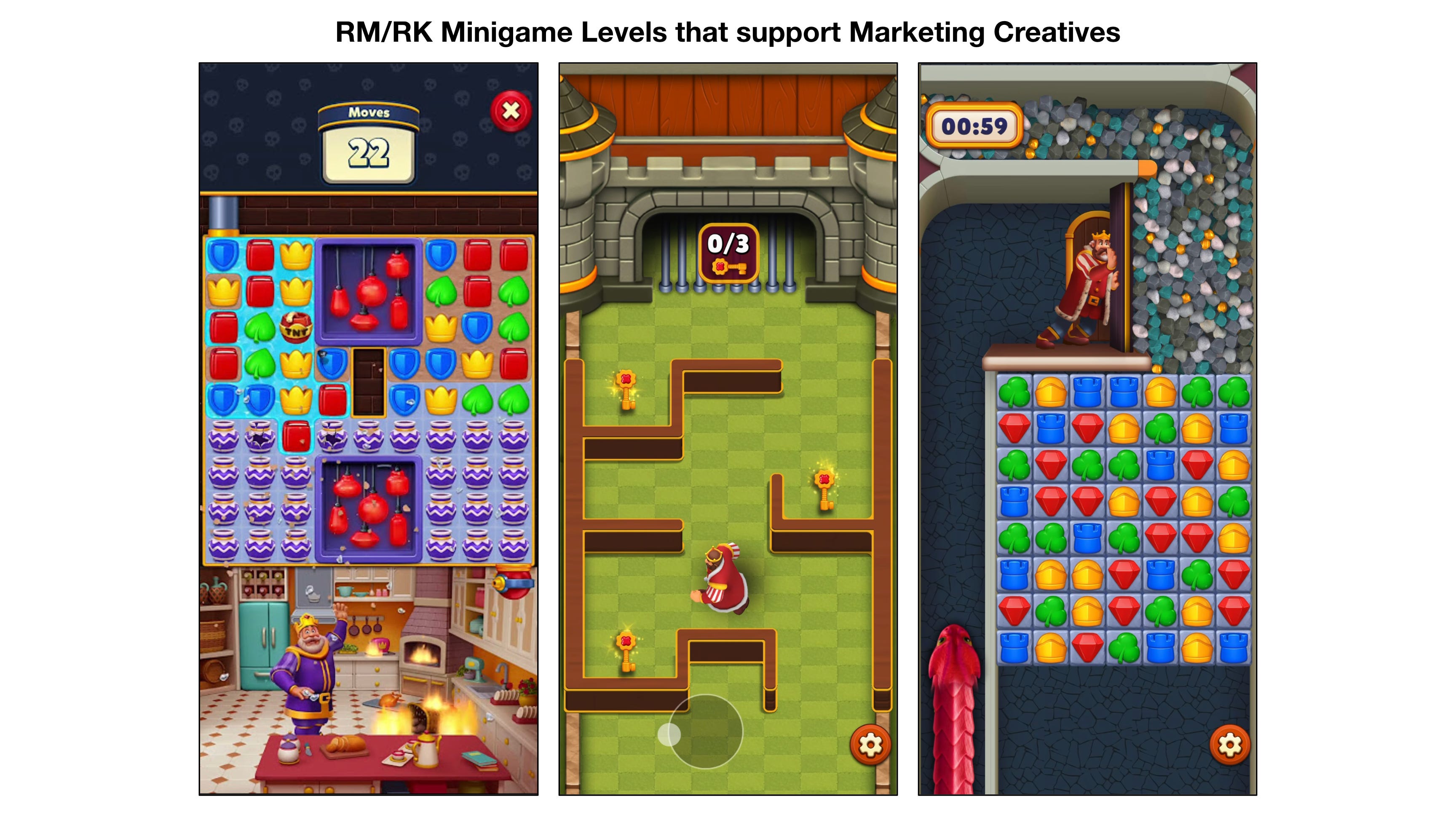
Optional minigame levels are highly effective because they serve a specific, low-friction purpose: they deliver on the promise of the UA creatives without blocking the player’s core progression. Examples include King’s Nightmare Level in Royal Match, or Richard’s Journey Level in Royal Kingdom. If a player fails or dislikes a timed “nightmare” level, they can skip it and return to the main level funnel. On the other hand, mandatory “innovative” levels offer no such escape — they sit squarely in the core level progression path, blocking progress if a player fails them.
Given that most match-3 players primarily play for decompression and frictionless escapism, the impact of introducing such “innovative” levels on the core level progression path can be understood by looking at a standard 10-level cadence across several titles. Since titles use a repetitive sequence of player-facing tags (such as “Hard” or “Super Hard”) to signpost upcoming level difficulty, we can map this cadence to the player’s required cognitive state based on the type of level being played. We assigned three distinct modes of cognitive engagement to three distinct level styles: “relaxed” for normal levels, “attentive” for hard or super hard levels, and “concentrated” for innovative levels.
Games like Royal Match (RM) excel by keeping players in a comfortable, oscillating flow state. Rather than forcing players into a high-friction “concentrated” state, they carefully balance the experience between relaxed pattern recognition for normal levels (the blue zone) and mild attentiveness for harder levels (the green zone).
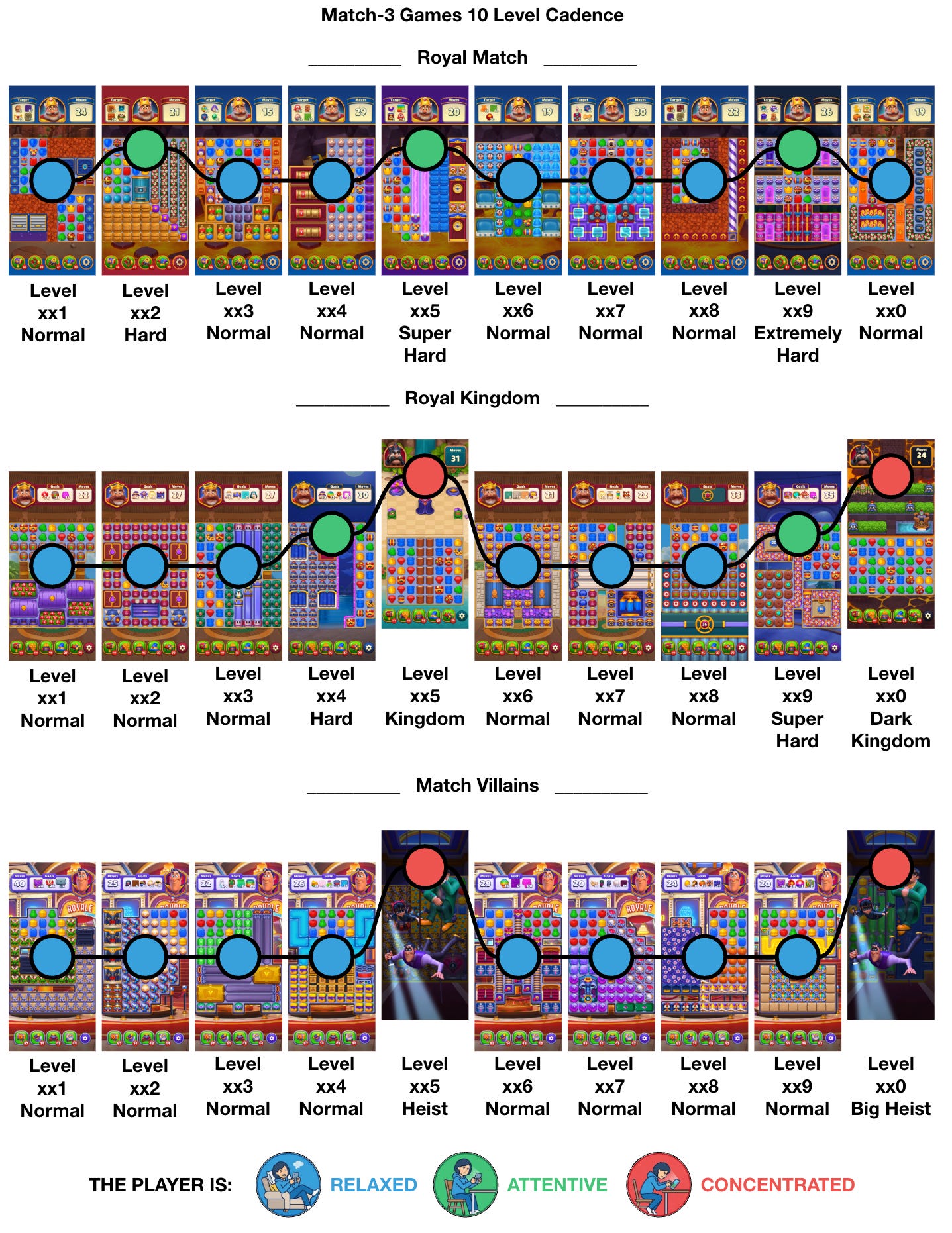
When developers inject such mandatory “innovative” levels into the core level progression funnel, they fundamentally change the game’s cognitive experience. Players are forced to pivot from clearing targets with regular match-3 rules to fighting onboard entities, utilizing tactical targeting, and managing new gameplay rules. This creates a severe spike in cognitive friction, moving the player into a high-effort, concentrated state for such “innovative” levels (the red zone).
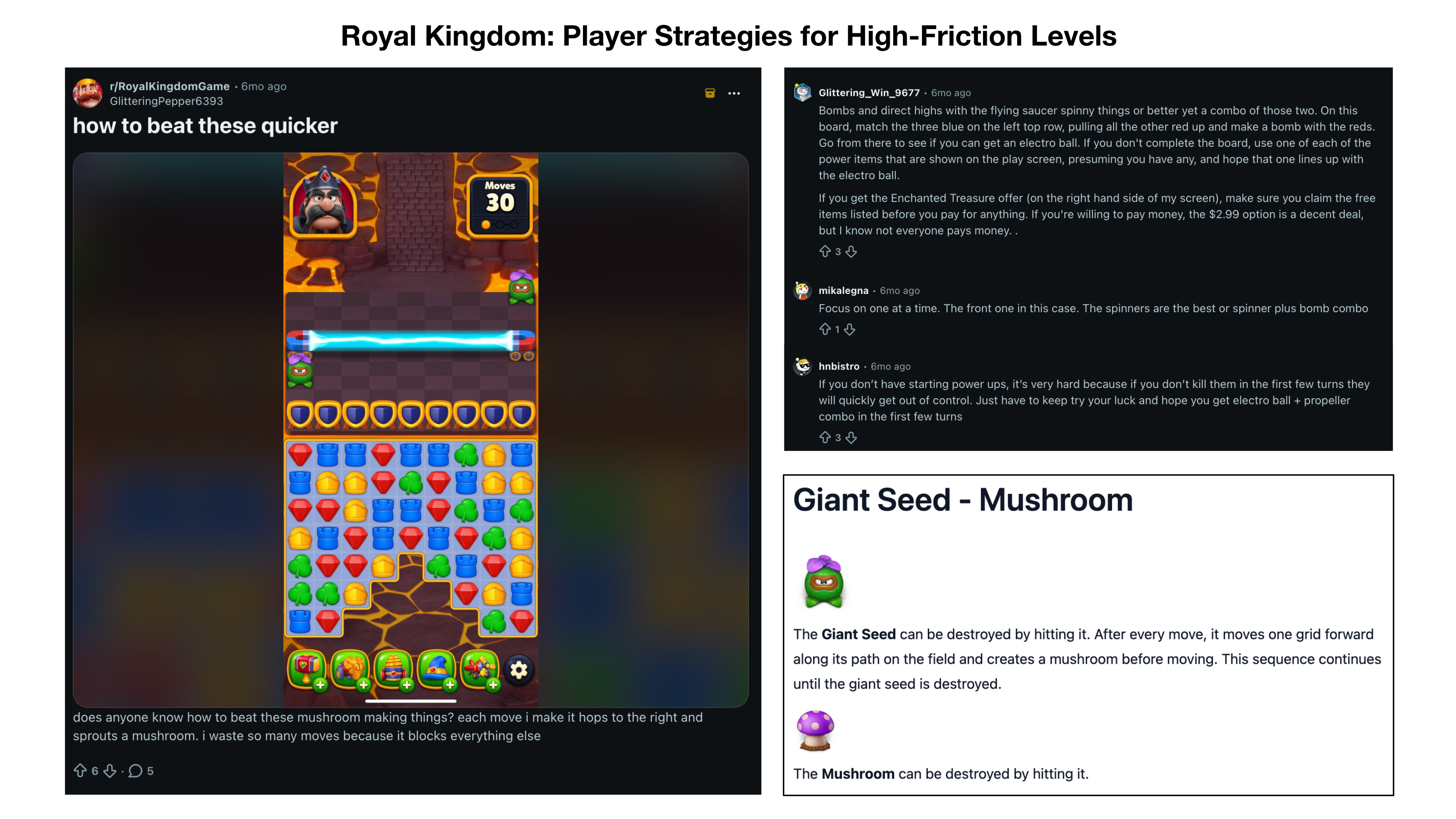
As the community thread above highlights, standard match-3 board-clearing logic is quickly abandoned in favor of deliberate tactical off-board targeting and reliance on specific, high-value booster synergies just to prevent the level from spiraling out of control.
This friction doesn’t just affect the moment of play — it alters the player’s session-initiation habits. Mobile puzzle games thrive as “second-screen” experiences. Players engage with them while watching content, doing household chores, or walking their pets. However, once players become aware that they might hit an “innovative” level requiring concentrated attention, the game loses its status as a reliable, low-stakes companion.
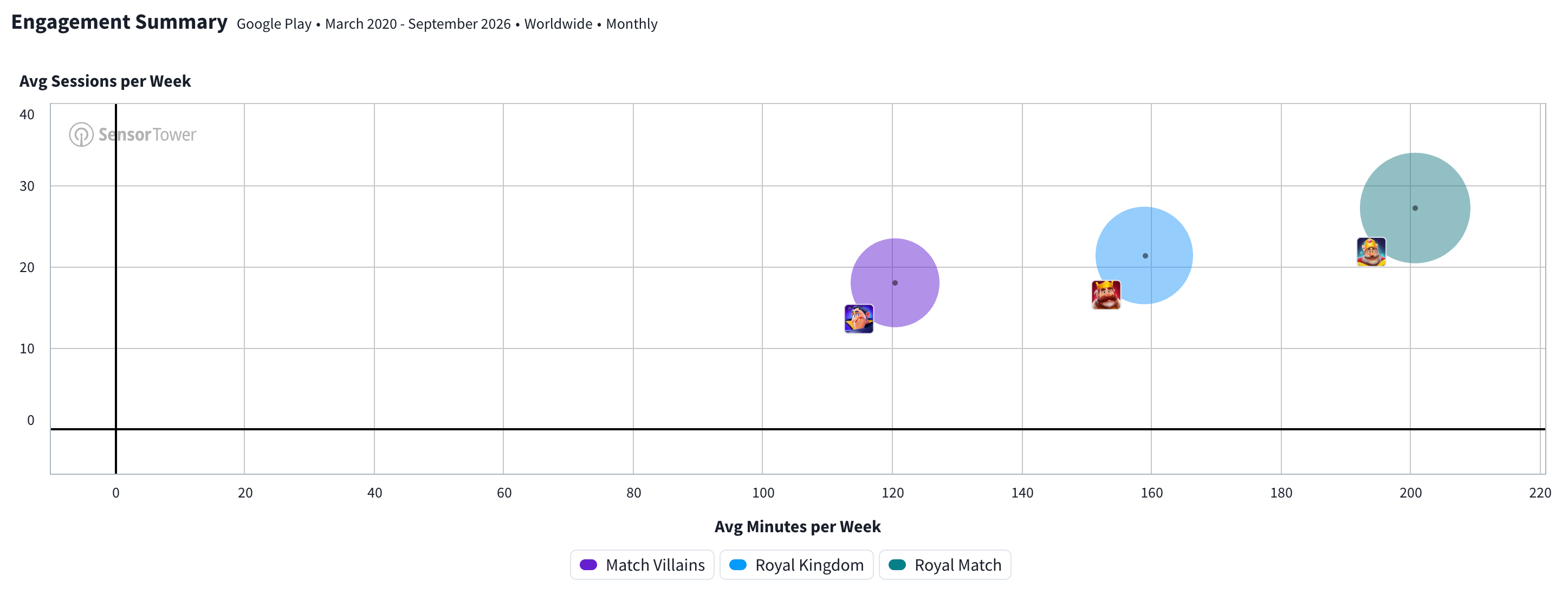
The impact of this likely contributes to the top-line engagement data, where titles leaning into these higher-friction mechanics — like MV and RK — see noticeably lower average weekly sessions and minutes compared to Royal Match. As a reminder — while level design is only one of many elements that contribute to overall engagement metrics, players spend the vast majority of their session time within the levels themselves. This likely means the engagement data above has a strong positive correlation with a game’s level design and pacing structure.
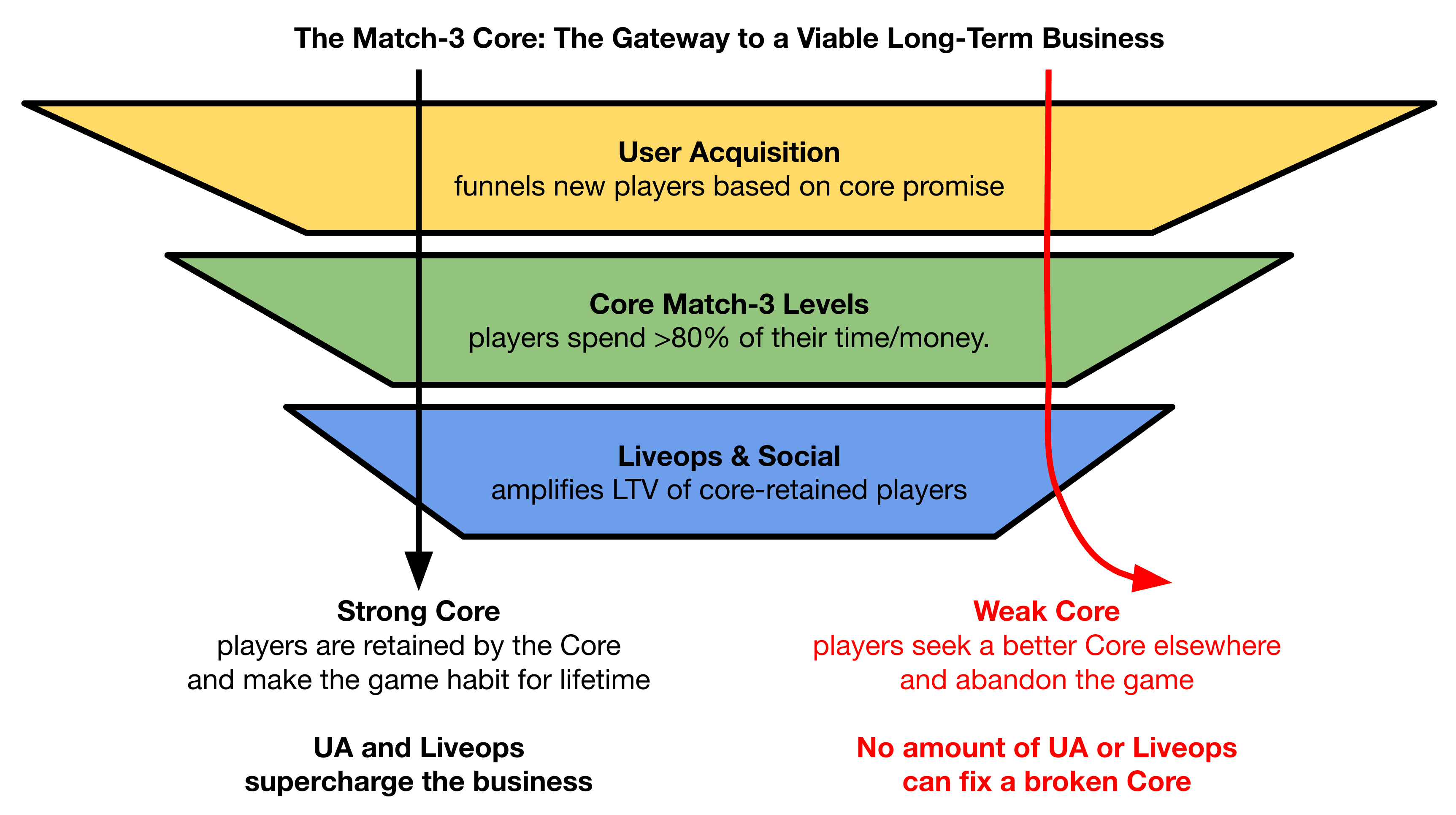
Viewed holistically, forcing “innovative” levels into the core progression risks filtering out mass-market casual players and boxing the game into a smaller niche. Because players spend over 80% of their time and money within levels, this core experience is the ultimate gateway to a game’s long-term viability. Anticipating high cognitive effort kills the desire to play during casual, multi-tasking moments, actively preventing daily habit formation.
If developers introduce unnecessary friction simply to secure a USP or strengthen an IP, players will churn for a smoother experience elsewhere before live-ops and social features can increase their LTV. Ultimately, no amount of aggressive UA can fix a frustrating core loop that stunts daily engagement and breaks the fundamental CPI < LTV equation required to scale.
Novel Innovations Matter Less than Player-Aligned Ones
While innovation within the match-3 genre must absolutely continue, developers should be incredibly deliberate about where they introduce friction, especially if appealing to the mass-market match-3 audience is a key business priority. In that scenario, the core puzzle board must remain a frictionless, approachable power fantasy designed for the mass market. Ultimately, the kind of innovation that excites developers must align with the experience that actually makes players commit to a game for a lifetime. As developers venture into unproven level design, the ultimate heuristic is simple: “Will this innovation actually make more players love my game more?”
A concrete market example of what this kind of player-aligned innovation looks like can be found in none other than RM. Prior to RM’s 2021 launch, the top-grossing puzzle ecosystem — dominated by titles like Candy Crush Saga, Homescapes, and Gardenscapes — routinely cluttered boards with non-essential obstacles that sat alongside the actual win targets. As the comparison below highlights, Royal Match introduced a defining shift in mass-market match-3 level design: slashing cognitive friction by fundamentally streamlining the player’s objective.
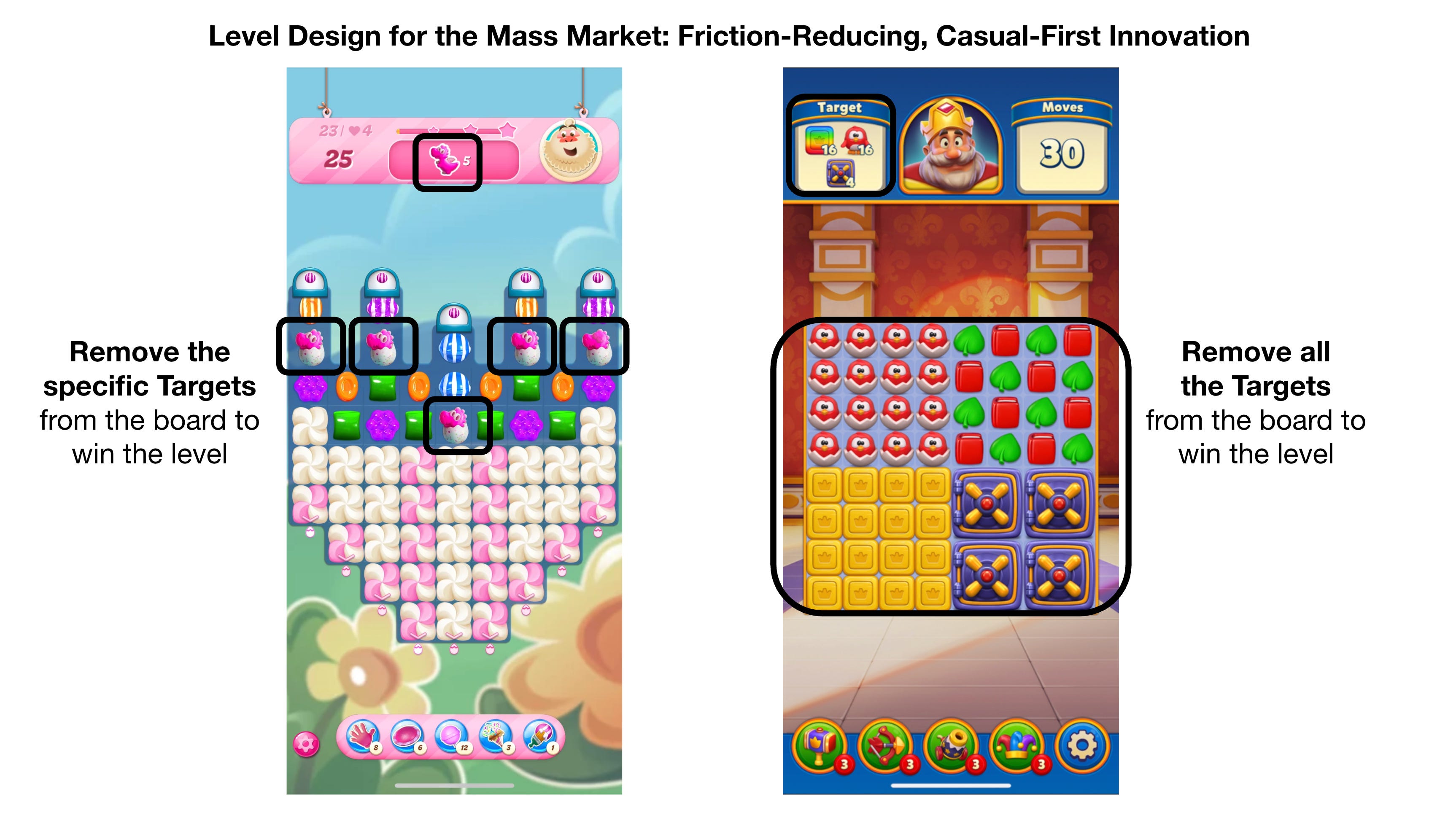
Legacy design paradigms, as seen on the left, forced players to hunt down specific, isolated targets scattered across the board, demanding active visual scanning and tactical precision with every move. In contrast, RM refined (read as “innovated”) the core experience by adding obstacles into massive, uniform clusters with a single, intuitive mandate: clear the whole board. Players rarely need to check the UI counters because the objectives dominate the play space, front and center. This deliberate level design shift dramatically reduced the cognitive effort required to play. Since almost any match or explosive combo inherently drives progress, players effortlessly enter a frictionless, low-stakes flow state perfectly calibrated for maximum mass-market appeal.
Expectations and financial ambitions for “innovative” match-3 games were incredibly high. These games were built by top-tier studios, backed by top-tier investors, and accelerated by massive UA budgets. Yet, the actual market results from the genre’s most ambitious contenders paint a bleak picture.
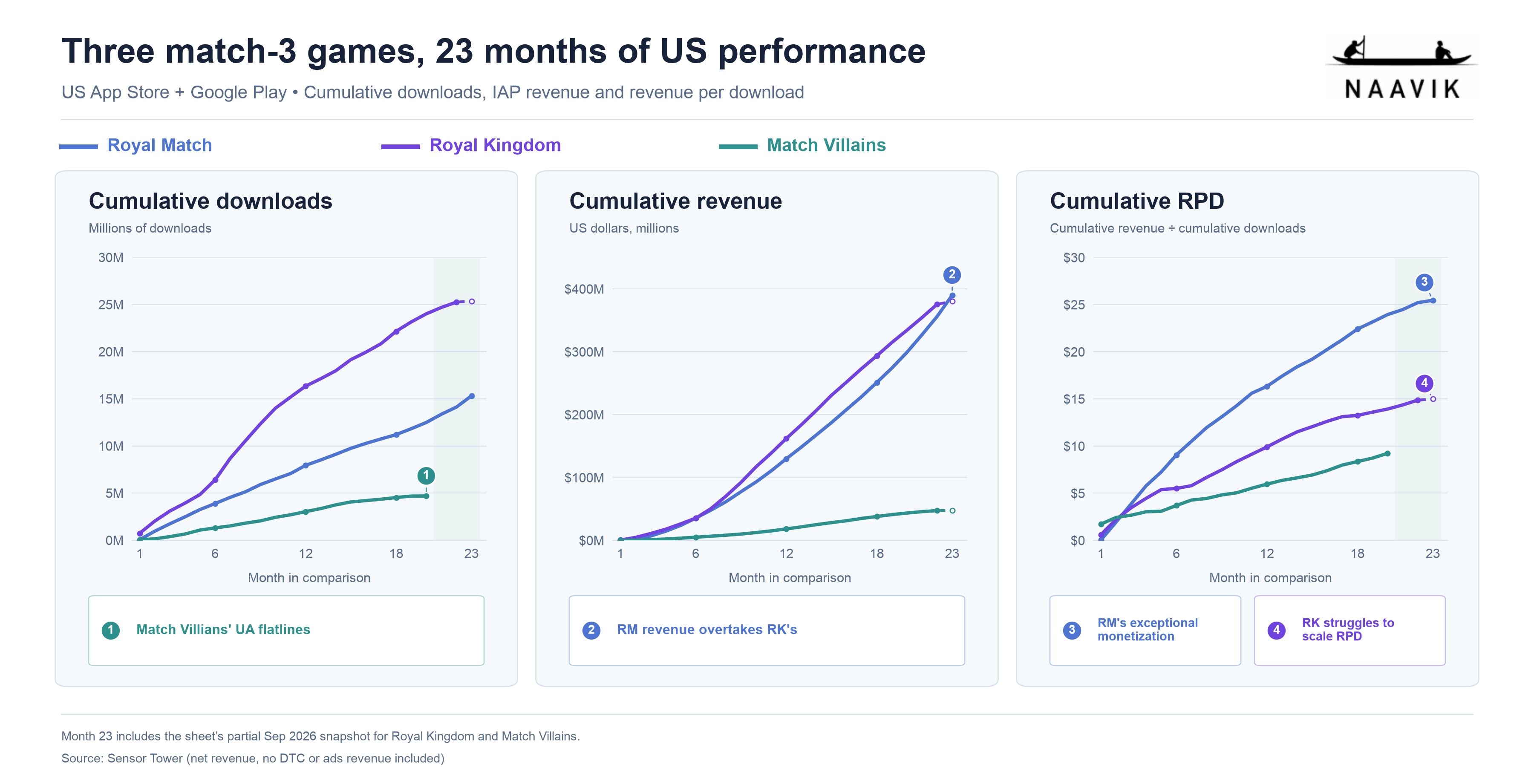
Looking at the first 23 months of cumulative U.S. performance, RK’s U.S. RPD has plateaued at around $15, versus RM’s $25. Despite RK securing a little more than 1.5 times RM’s download volume over the same period and Dream Games continuing to support the game with significant UA spend, RK’s monthly revenue has flatlined at ~$20M, actively dragging down the studio’s overall portfolio performance rather than expanding it. The wider market echoes this trajectory: Match Villains recently pulled back its U.S. UA spending, while the $50M-backed Pet Panic completely shut down after its 21-month soft launch.
RM spearheaded the core-first, meta-lite, and live-ops-heavy paradigm that dominates the top-grossing puzzle charts today. However, the next generation of match-3 hits won’t be born from studios chasing innovation for its own sake. Instead, the future of the match-3 genre likely belongs to those who master player-aligned innovation. Whether that takes the form of inventive level design or ruthlessly stripping away friction from the core loop, every innovation effort must directly deliver the specific value and frictionless escapism casual players crave. It took a full decade for the market’s #1 title to evolve from Candy Crush Saga to Royal Match. Now, a little over three years into Royal Match’s dominance in this fast-moving market, the time is ripe for a new leader to emerge by perfectly aligning their innovation with players.
Sponsor: Better Matches, Steadier Spikes: Whatwapp's Matchmaking Case
Whatwapp used Heroic Labs to move from synchronous to asynchronous matchmaking. This change delivered better-balanced matches and steadier handling of traffic spikes, reshaping how their team approaches matchmaking design.
Top News Items
Written by Max Abrahamsen, Consultant at Naavik
PIF reportedly considers merging EA and Savvy Games Group
Saudi Arabia’s Public Investment Fund is reportedly considering combining two games businesses already under its control: Electronic Arts and Savvy Games Group. The proposal seems intended to bring PIF’s main gaming assets under one corporate umbrella, giving it a simpler way to manage and coordinate its wider strategy. Earlier this year, PIF made a similar move by beginning to transfer roughly $12 billion in gaming investments to Savvy, without changing how the individual stakes were managed. At this stage, the proposal looks more like a consolidation of ownership than a significant change on how the consolidated entity will operate.
Roblox plans to let creators publish games as standalone apps
Roblox plans to let creators release their games as standalone apps across mobile, PC, and consoles, with Roblox still providing the technology behind the games. This matters because creators currently depend heavily on Roblox’s own app and discovery system to reach players. However, the “Roblox Everywhere” strategy allows these very creators to distribute their games on third-party, already scaled platforms. At the moment, it’s not fully clear how Roblox plans on converting this strategy into a new revenue stream for itself. But, it’s important to remember that Roblox opening this possibility with third-party platforms also means Roblox having to be okay with the rules of these third-party platforms.
Apple unveils first foldable iPhone with a new canvas for mobile games
Apple has unveiled the iPhone Duo, its first foldable phone. It has a 5.4-inch outer display and opens to reveal a 7.6-inch screen, which is 50% larger than the display on the iPhone 18 Pro Max. The phone also comes with Apple’s A20 Pro chip and a new cooling system. Apple claims these deliver up to 35% better sustained performance than the iPhone 17 Pro. In practical terms, that should mean less slowdown when the phone heats up during longer gaming sessions. For developers, though, the foldable display is the more significant change. Games will need to support two screen sizes and account for whether the phone is folded or unfolded. Apple has released updated tools to help with this, although developers will still have to spend time on design and testing. With the Duo starting at $1,999, it may take a while to build a large audience. Developers will have to judge whether supporting the larger display is worth the additional work.
Other News Items
Product & Marketing
Ludus generated $29m in the first half as its second quarter reached a new record
Monster Hunter Outlanders reaches 5m pre-registrations in three weeks
Last War: Survival revenue declines for a fifth consecutive month
Companies & Capital
James Nicholas becomes Trailmix CEO as Carolin Krenzer moves to executive chair
King faces a potential Swedish strike after rejecting a collective bargaining agreemen
Platform, Technology & Tools
Apple’s revised EU App Store terms face coordinated developer backlash
UK tribunal approves a £260m Google Play settlement with app developers
AppsFlyer expands attribution to organic AI referrals and ChatGPT Ads
Miscellaneous
Content Worth Consuming
An oral history of mobile user acquisition (with Nebojsa Radovic) (MobileDevMemo): “On this week’s episode of the podcast, I am joined by my friend Nebojsa Radovic, the Senior Director of Mobile User Acquisition at Zynga and a battle-hardened mobile marketing veteran. In the course of our conversation, we discuss the evolution of mobile user acquisition from the era of manual campaign configuration to the contemporary operating environment of automated, AI-driven workflows.”
Questions Istanbul Founders Stopped Asking, with Akin Babayigit (Deconstructor of Fun): “Turkish studios have gone deep instead of wide. People build what they worked on. Someone who spent five years at Peak is not going to go build World of Tanks. Capital is available for what has already worked. Talent is available for what has already worked. The loop closes.”
D2C isn’t a payment method: Inside a webstore doing 70% of revenue (Pocketgamer.biz): “I think the main takeaway here, as we all know, is we’re not reaching double-digit growth currently. We’re in a mature market, so publishers will be looking for how to increase their margins on their existing user base, such as through direct-to-consumer.”
State of Digital Advertising 2026 (Sensor Tower): “Artificial intelligence has rapidly moved from an experimental tool to an operational core in ad creative production. As generative image, video, and text tools improve, brands are leveraging shorter production cycles to scale creative testing and iterate faster.”
Trailmix on five years of Love & Pies: “There is no status quo in live service” (Pocketgamer.biz): “The thing I keep coming back to is that there are people who downloaded Love & Pies in September 2021 and have popped into the Windmill Café pretty much every day since,” she says. “Five years of someone’s free time is an extraordinary thing to be trusted with.”
Mobile game influencer marketing: What actually works, according to someone who’s spent $30M finding out (Mistplay): “What I kept running into was that dedicated influencer marketing expertise barely existed as a function inside most studios,” Balinoff says of the gap that eventually led her to go independent. “It was usually bolted onto someone’s UA or marketing role.”
More About Naavik
Naavik’s team of experts has helped over 300 companies — publishers, studios, tech companies, and investors — succeed across the video game industry. We’d love to work with you too! Here’s how we can help, spanning all platforms, genres, and regions:
Strategy Consulting: Market research, corporate strategy, game and economy design, gamification, live-ops strategy, AI strategy, product management, brand and performance marketing, and more.
M&A and Investment Advisory: Expert commercial due diligence for buyers, fundraising support for sellers, and fractional CFO/CSO services.
Fractional Talent: The one-stop shop for top-tier fractional talent covering dozens of game industry roles — analytics, design, marketing, art, QA, and more.
Check out the links above to learn more. If you'd like to discuss how Naavik can support your team, click the box below or send us a note at consulting@naavik.co.