
Hi everyone! Welcome to this week’s Naavik Digest.
This week, we explore the commercial value of licensed IP, from where it’s strongest to how it shifts across price and quality tiers. In a new podcast episode, we sit down with Michael Metzger to unpack gaming financing.
Naavik’s latest AI x Gaming newsletter explores Roblox’s extensive use of AI to evolve its platform. Check it out here if you haven’t had a chance yet.
Podcast: Is Gaming in an AI Bubble? What the Deal Data Says
Gaming financing hit a 12-month high in Q2 2026, with over $2.5B raised. But there’s a catch: fewer than 100 rounds accounted for the capital, down from roughly 200 per quarter just a few years ago. So where is the money actually going, and what does that say about the gaming market?
In this episode, recorded in person at Gamescom, Kalie Moore sits down with Michael Metzger, Managing Partner at Drake Star Partners and head of its gaming and digital media practice, to unpack what the latest deal data reveals about where investors and acquirers are placing their bets.
Sponsor: Lifting Every Core KPI at Launch: Case Gray Zone Warfare
When MADFINGER expanded from mobile to PC, they used Heroic Labs to build a preview mode with full progress carryover. Read how the work led to increases in every core KPI from CCU to DAU/MAU, retention and session length, at launch.
The Real Value of Licensed IP
Written by Jordan Phang, Naavik Contributor and Design Director at Altitude Games
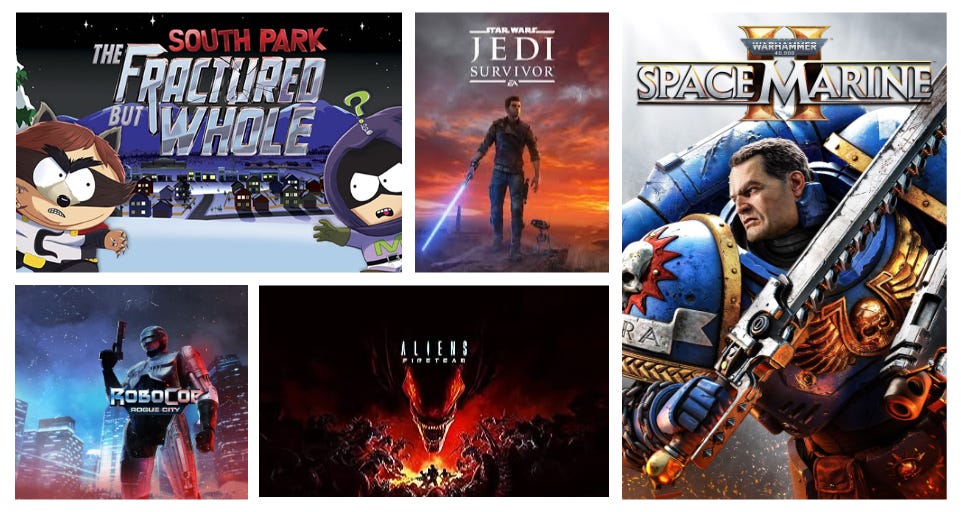
Star Wars Zero Company recently released to critical and consumer acclaim. According to VG Insights, it has sold more than 800k units and earned $36M in revenue. Yet court filings from an ongoing lawsuit between co-founders revealed that 80% of the team had been furloughed prior to release.
The struggle of one of the best-reviewed Star Wars games got us thinking about a broader question: what is an established IP worth to a game? If you combine a top-tier IP with a top-tier game, you should be printing money, right?
To be clear, Zero Company’s circumstances were complicated. A lawsuit seeking $20M in damages put additional pressure on the company’s focus and resources. That said, the question remains: When a studio licenses an external IP, what exactly is it getting, and what can the studio expect in commercial outcomes?
Conventional wisdom says IP brings visibility, exposure, and a built-in audience. It’s certainly a view shared by some of the biggest publishers in the world.
“It’s tough to get attention . . . you can’t argue with the fact that having a known brand out there is a way for you to get attention.” – Karl Slatoff, President of Take-Two Interactive Software (Q2 2024 Earnings Call)
“So, we consider this licensed IP an incredibly important component of expanding, diversifying, and casting our net wider to bring new players in.” – Laura Miele, COO of Electronic Arts (Q2 2023 Earnings Call)
On the surface, it makes sense. In a crowded market, recognizable IP gets attention and brings a built-in audience.
But it doesn’t come for free.
In 2024, EA CEO Andrew Wilson said the company would be “moving away from development of future licensed IP that we do not believe will be successful in our changing industry.” Reuters also reported that Tencent was pulling back from some External IP deals, in part due to high royalty fees.
This is the flip side of IP. You get awareness and an existing audience, along with licensing fees, royalties, creative constraints, and higher expectations.
So the real question is: to what extent does External IP improve commercial outcomes enough to justify the trade-offs?
To find out, we analyzed Steam performance data for External IP and Original IP games released over the last decade.
Methodology
Before we could begin, we needed to classify games based on the IP type.
Owned/Group-Controlled IP: Existing IP owned by the publisher or its controlling company group, such as Batman under Warner Bros. Discovery or Assassin’s Creed under Ubisoft.
External IP: Existing IP licensed from an unrelated rights holder, such as Marvel Rivals, Marvel’s Spider-Man, or Warhammer 40,000: Space Marine. We exclude sequels in the same game series to avoid conflating the value of the licensed IP with the additional brand equity created by a successful previous game.
External Sports IP: Sports and racing licenses, which we separated due to their very different licensing dynamics.
Original IP: A new IP without a pre-existing audience or brand. The first Assassin’s Creed is therefore Original, while its sequels become Owned/Group-Controlled IP. As with external IP, sequels are excluded so we don’t conflate the value of the underlying IP with the additional brand equity created by a successful previous game.
For this analysis, we only compared External vs. Original IP, looked at games released between 2015 and 2025, and filtered out titles with fewer than 10,000 lifetime units sold. This left us with 13,773 games, including 436 External IP titles.
The other challenge was age. A 2015 game has had a decade to accumulate sales while a 2025 game hasn’t. So for each release year, we used the median Original IP game from that year as the benchmark and measured every game against it. A value of 2.0 therefore means a game sold twice as many units as the Original IP median from the same year.
Finally, one caveat: this is observational data. The uplift captures the commercial advantage associated with External IP, not necessarily the isolated causal effect of the license itself.
External IP Amplifies Success Rather Than Prevent Failure
The table below compares games based on their lifetime unit sales relative to the median Original IP game released in the same year. A value of 1.0 represents the Original IP median, while 2.0 represents twice that benchmark.
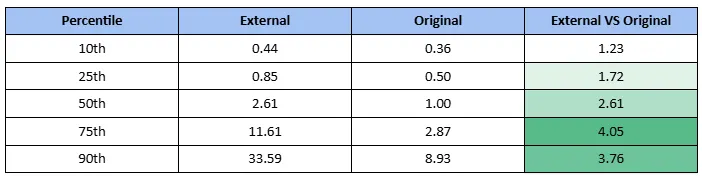
At every measured percentile, External IP games performed better than Original IP games. This effect grew significantly toward the upper end of the performance spectrum, increasing from 1.23x at the 10th percentile to ~4x at the 75th–90th percentiles.
However, that does not mean External IP eliminates the risk of failure. The bottom 25% of External IP games still sold fewer units than the median Original IP game. Instead, the data suggests that External IP shifts the distribution of outcomes upward.
But we noticed something interesting when performing our analysis. When we plotted sales uplift in more granular percentile buckets, a pattern emerged.
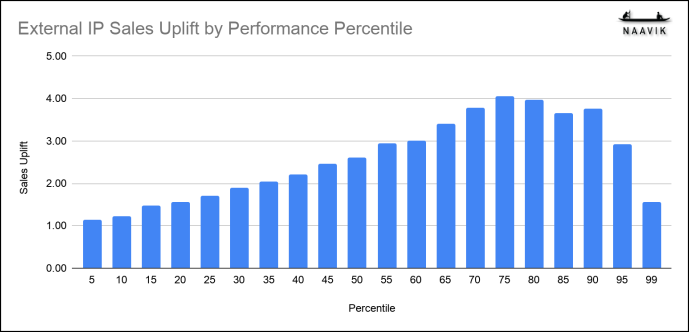
At the lowest levels, there was no real difference between an External IP flop and an Original IP flop. The advantage then grew continuously, peaking around the 70th–80th percentiles before falling again at blockbuster scale (because blockbuster games already generate such strong demand).
Put simply: External IP is much better at amplifying success than rescuing failure.
The External IP Sweet Spot Appears to Be Good, Not Great Games
But the chart above got us thinking. Does player reception change the value of External IP? We therefore repeated the analysis using Steam review tiers.
In the table below, each External IP game is benchmarked against Original IP games released in the same year and carrying the same Steam review rating, allowing us to isolate how the External IP advantage varies by player reception.
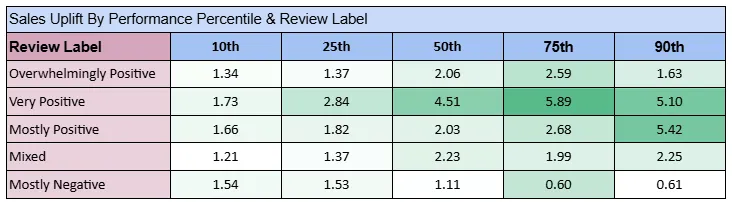
Interestingly, the biggest External IP uplift wasn’t among Overwhelmingly Positive games. Instead, it was the tier below: Very Positive. Games in the Very Positive tier delivered a median 4.51x uplift, compared with just 2.06x for Overwhelmingly Positive games.
The key takeaway is that External IP amplifies games most strongly when they are good but not exceptional — before quality or virality alone drives a breakout.
Original IP Games Need to Reach a Higher Bar of Quality
This prompted another question. Does External IP lower the quality bar for commercial success? Rather than comparing games within the same review tier, we benchmarked every game against the median Original IP game released in the same year, then grouped the results by review rating. Does External IP keep its advantage?
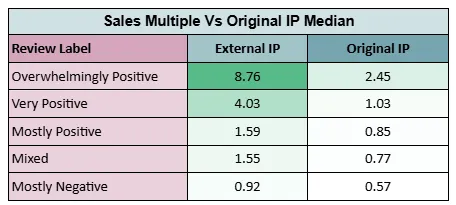
The answer is yes. In fact, what’s even starker here is that Original IP games need to clear a very high bar. A Very Positive rating only gets Original IP games to median sales performance, while External IP games can scrape by with a Mixed rating and still exceed median.
External IP Is Concentrated On Higher Price Tiers, the Opposite of Original IP
One thing we hadn’t controlled for was production scale or actual revenue. Undertale and Mortal Kombat X both generated roughly $50M on Steam according to VG Insights, but they represent very different commercial propositions.
So we bucketed the games by launch price as a proxy for commercial ambition. Because VG Insights only shows current pricing, we pulled historical pricing from IsThereAnyDeal, leaving us with around 10,400 games with usable data. The results were interesting.
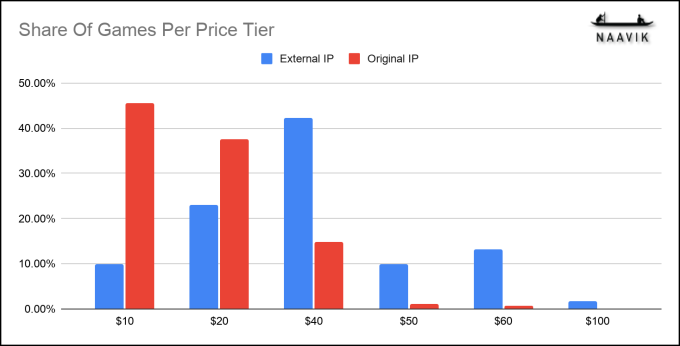
There are a couple of notable insights here. First, Original IP games were highly concentrated in the $10–$20 range, while External IP peaked at $40. Second, there were comparatively very few Original IP games priced over $40.
External IP Has a Revenue Advantage Even for Games Selling at Similar Prices
The analysis above showed that we needed to compare games that were like-for-like for the next step of our analysis: finding the revenue differences between External IP and Original IP games. So we compared revenue within the same launch-price tiers. The table below benchmarks revenue for External IP games against the median Original IP game released in the same year and within the same launch-price bracket.
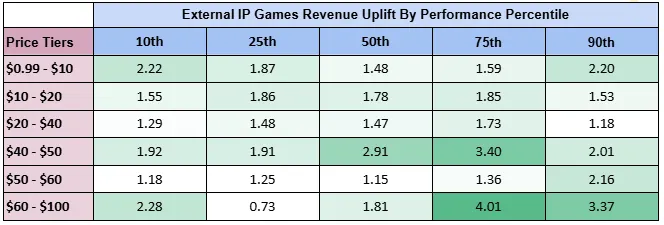
Even in this like-for-like comparison, External IP games still outperformed Original IP games in 29 of the 30 comparisons. The largest consistent uplift came from the $40–50 tier, peaking at 3.4x in the 75th percentile. The $60+ tier technically reached 4.0x, but only 10 External IP games fell into that bucket, so we’d treat the result as directional rather than conclusive and wouldn’t put much weight on the exact magnitude.
External IP Makes More Money, but Is It Profitable?
Revenue uplift is only part of the story. A 2x revenue advantage doesn’t mean much if it’s a $50 game making $1M vs. $500K.
To answer that question, we calculated median lifetime Steam revenue for each yearly cohort, then took the median across those yearly medians to determine the typical outcome.
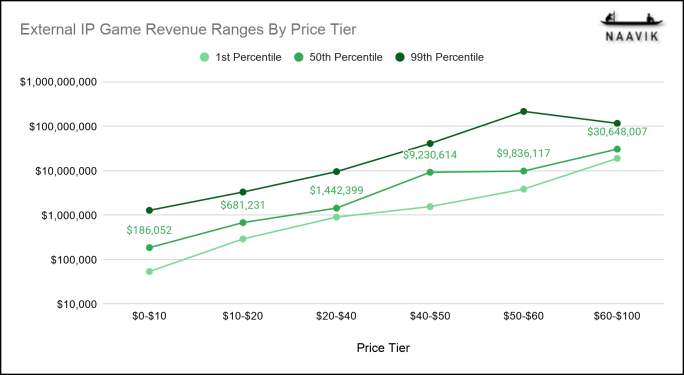
The results reframe External IP’s advantage. Even in the $50–$60 tier, the median External IP cohort generated only $9.8M in Steam revenue.
Not only that, revenue is not profit. Profitability also requires accounting for platform fees, development and marketing costs, and the cost of the license itself. Given these costs, is an External IP actually worth it?
It depends. On one end, you have Daedalic, which made a median-performing game in the $40 tier that cost $16M and generated $9M in revenue. Despite theoretically outperforming an equivalent Original IP game by 2.6x, the game still failed. The failure ultimately led the company to exit game development entirely and lay off 25 employees.
At the other end is Insomniac Games. Marvel’s Spider-Man: Miles Morales generated $260M in revenue against $156M in total costs, successfully amplifying the outcome compared to an Original IP.
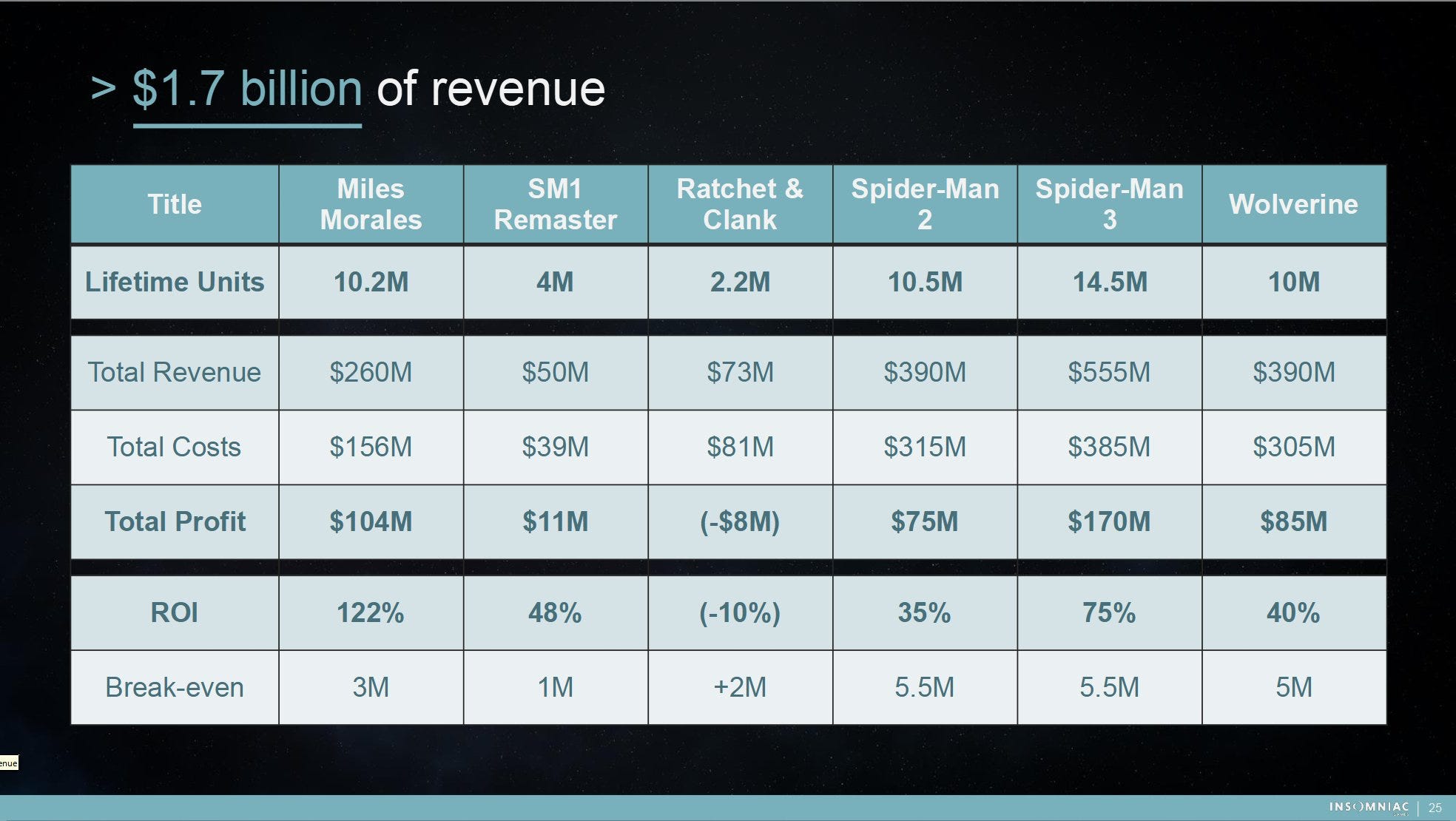
So despite all of the advantages that External IP brings, it is still a hit-driven business. To put it simply, External IP raises the upside far more than it protects the downside. In fact, it adds an element of risk via licensing fees.
The leaked Insomniac–Marvel terms showed royalties ranging from 9–26%, depending on SKU. To illustrate the impact on the economics, we applied a simple 20% royalty scenario to the revenue uplift.
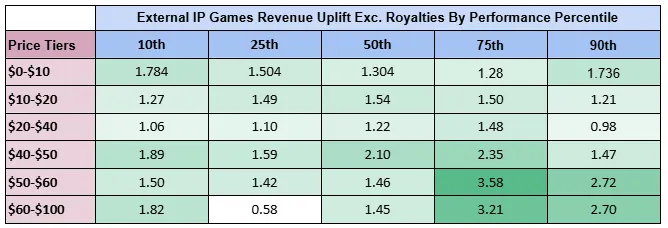
That juicy revenue advantage now looks a lot less exciting. At the median, the advantage went from 1.52x–2.62x down to 1.22x–2.10x — enough to make External IP less of a no-brainer and more of a deeply considered strategic lever.
Conclusion
So back to the original question: Does External IP improve commercial outcomes enough to justify the trade-offs? Yes and no.
On one hand, the answer is pretty clear. External IP improves commercial outcomes relative to an equivalent Original IP game. It sells more units, makes more revenue, and its advantage increases as games become more successful.
On the other hand, it doesn’t turn failures into hits, and you still need a home run to succeed.
Perhaps a more useful way to think about External IP is as leverage, not insurance. It can make a strong commercial proposition significantly more valuable, but it doesn’t magically make the underlying investment safer.
The best teams should still aim to create their own IP in order to be in control of their destiny — building a long-term business rather than a one-game hit.
For teams that want to leverage IP to boost their next game and can answer “yes” to the question “Will this IP help us sell enough more copies to outweigh the royalties, higher costs, complexity, and expectations that come with it?” External IP can be a powerful lever.
If not, they may just be paying more to make a bigger bet.
Sponsor: Stop Guessing Why Your Players Churn
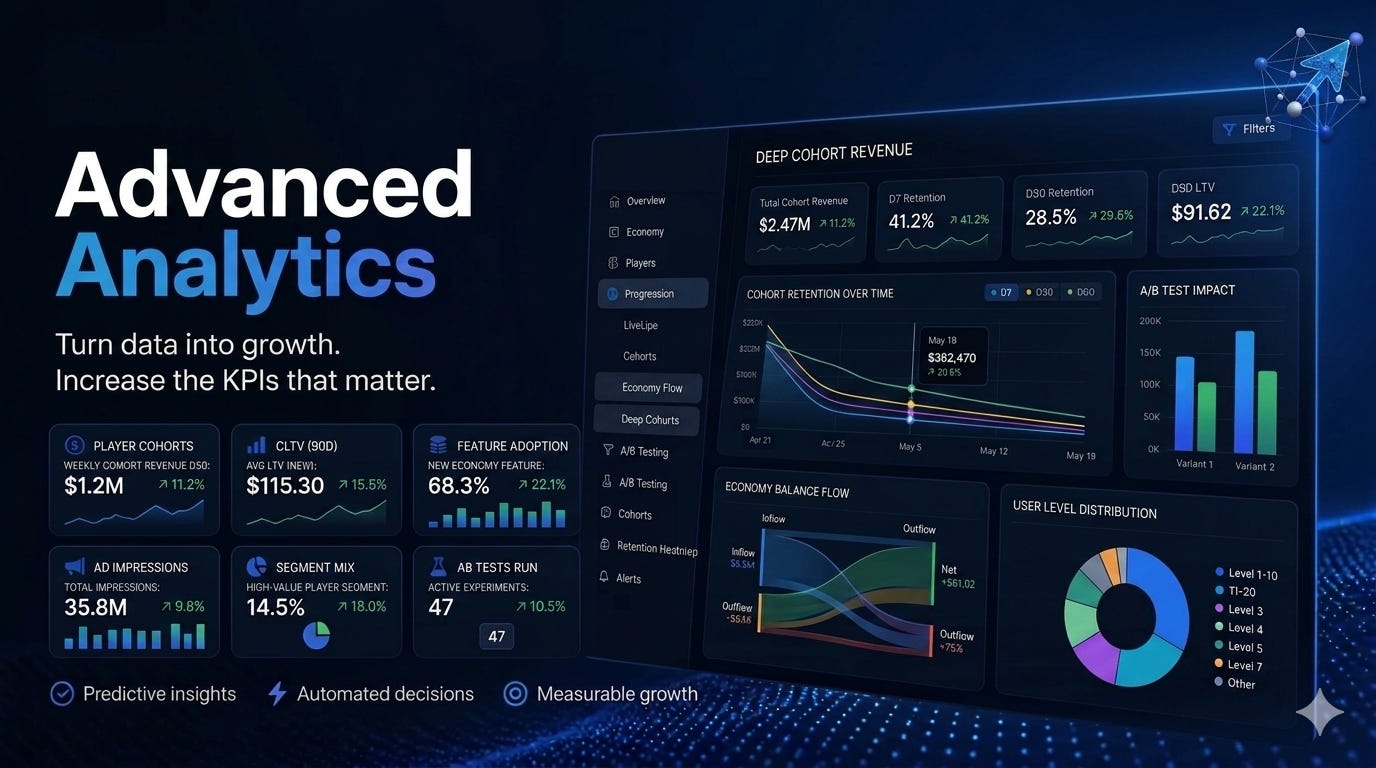
Most game studios are sitting on player data they can’t actually use. Reports are late, systems don’t talk to each other, and the insights that should be driving decisions are stuck in spreadsheets nobody trusts.
Dive fixes that. It’s a fully managed BI-as-a-Service platform built specifically for game studios — combining data engineering, analytics, segmentation, and an enterprise LiveOps system into one solution, without requiring an in-house data team.
95% of Dive clients grow revenue in their first year. Results across the portfolio include revenue uplifts of 2,000%+, 25% ARPDAU increases, and retention improvements driven by automated “likely to churn” player journeys — all delivered by a team that has operated at the highest levels of the games industry.
In Other News
💸 Funding and M&A:
Publishing house 1312 Interactive has secured $1M in a seed funding round
Bohemia Interactive takes minority stake in Everwind developer Enjoy Studio
Team17 owner Everplay increases shareholding in Wardogs dev Bulkhead, touts strong FY26 results
📊 Business & Product:
Competition Appeal Tribunal approves £260M Google Play settlement with UK app developers
STAN sees 15x growth in StanShop monthly buyers as repeat purchases hit 70%
Piñata returns as independent creative studio after Metacore stint
👾 Miscellaneous:
D2C isn’t a payment method: Inside a webstore doing 70% of revenue
Roblox creators will soon be able to publish games on multiple platforms as standalone apps
Remedy’s Arhi Makkonen on designing the “biggest world we have ever done” for Control Resonant
New StarCraft title to launch in 2030, will be an open-world FPS
Content Worth Consuming
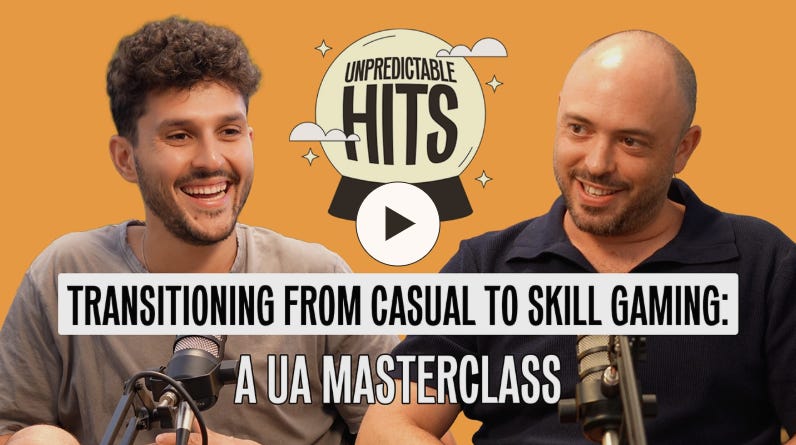
Uri Pearl: Papaya Gaming’s VP Marketing on Skill Gaming, Player Motivations & TV Builds Legitimacy (Unpredictable Hits): “In this episode, Amit Carmi, CEO at Sett, sits down with Uri Pearl, VP of Marketing at Papaya Gaming, to talk about marketing in one of the most successful and least understood corners of the industry: real-money skill gaming. They get into why skill gaming gave Papaya a real edge by skipping the 30% app store fee, how Uri markets to three completely different players at once, the money-led, the challenge-led, and the casual crowd he has to convert, and why building a player's confidence matters far more than telling them to ‘use your skills.’ They also dig into how CTV and television make gaming feel legitimate, the emotional pull behind campaigns like Swing and Play For Real, what it really takes to land in a new country like the UK, why a familiar genre like Solitaire travels while Triple Match doesn't, and how research and strategy become the real moat as AI commoditizes creative production.”
Beyond Balatro: Why PlayStack Doesn’t Want a 100% Hit Rate (The Game Business): “In this bonus edition of The Game Business Show, Chris talks to Balatro publisher PlayStack about how the hit poker game has transformed the company, why it's not looking for a 100% hit rate, and what it expects from its new owners.”
LEGO Batman: Legacy of the Dark Knight with TT Games’ Jonathan Smith (The AIAS Game Maker’s Notebook): “Trent Kusters chats with Jonathan Smith, Vice President, Product at TT Games. Together they discuss his path from the LEGO Company to TT Games and helping define the pillars of a LEGO game; the importance of teamwork and consistency towards their continued success; working with DC to bring the entire Batman universe into a definitive experience with LEGO® Batman™: Legacy of the Dark Knight; and how they balanced the grittiness of the Batman IP with the joy and whimsy of the LEGO brand.”
An Oral History of Mobile User Acquisition (with Nebojsa Radovic) (Mobile Dev Memo Podcast): “On this week's episode of the podcast, I am joined by my friend Nebojsa Radovic, the Senior Director of Mobile User Acquisition at Zynga and a battle-hardened mobile marketing veteran. In the course of our conversation, we discuss the evolution of mobile user acquisition from the era of manual campaign configuration to the contemporary operating environment of automated, AI-driven workflows. We reflect on how the industry has shifted from highly technical, high-headcount operations toward lean, specialist teams focused principally on creative optimization and signal engineering.”
“I Really Want Criterion to Be Considered the Best Studio in the UK” — Why the Home of Burnout Has a Future with Battlefield (gamesindustry.biz): “A certain generation of gamers – the older ones – will associate the British studio's name with the white knuckle Ronin-car-chase-inspired racing of Burnout, with its chaotic destruction and punk rock soundtrack. It's the franchise that made the studio's name, and for a period the lobby of its Guildford offices had a sculpture of a car bursting through the wall to commemorate it. The racing expertise was subsequently applied to Need For Speed, both at Criterion and sister studio Ghost Games, and Criterion delivered what's currently the last game in the franchise, 2022's Need for Speed Unbound.“
Playables Are Now 40-60% of Creative Spend: Here’s What’s Working Now (two & a half gamers): “Matej Lančarič and Ondrej Mosberger are joined again by Robin Kuyer (Unity PlayWorks) for the "everyone brings playables" format — with the bold creative twist of reversing the order. They open on the data: Matej's Brutally Honest UA report puts playables at 40-60% of creative spend, up from 30-40% a year ago, as AppLovin, Mintegral, and the SDK networks keep growing. Robin brings the "Frankenstein" playable (Wool Crush: arrows + yarn mechanics + save-the-cat, every popular concept stacked into one ad — plus his spreadsheet method for engineering ideas from what's trending), the non-gaming wave. Ondrej closes with a Fumb Games playable vibe-coded in Playable Maker (30 iterations and the next version does it in three) and a clean memory-game hidden-object playable that respects the player's intelligence.”
More About Naavik
Naavik’s team of experts has helped over 300 companies — publishers, studios, tech companies, and investors — succeed across the video game industry. We’d love to work with you too! Here’s how we can help, spanning all platforms, genres, and regions:
Strategy Consulting: Market research, corporate strategy, game and economy design, gamification, live-ops strategy, AI strategy, product management, brand and performance marketing, and more.
M&A and Investment Advisory: Expert commercial due diligence for buyers, fundraising support for sellers, and fractional CFO/CSO services.
Fractional Talent: The one-stop shop for top-tier fractional talent covering dozens of game industry roles — analytics, design, marketing, art, QA, and more.
Check out the links above to learn more. If you'd like to discuss how Naavik can support your team, click the box below or send us a note at consulting@naavik.co.