
Hi everyone! As we teased a couple of weeks ago, Naavik Digest has officially moved to Substack. Now we have all of our newsletters — including AI x Gaming and Mobile F2P — in one place!
For anyone confused:
Naavik Digest covers the trends and companies shaping the future of gaming (published weekly)
AI x Gaming digs deeper into how AI will inevitably reshape the industry (published biweekly)
Mobile F2P explores the games and genres defining today’s mobile industry (published biweekly)
Of course, there will occasionally be light overlap, and there is always more to come. If you want to read everything, awesome! If you don’t, we understand. Substack makes it easy to choose which emails you receive. Here's how: go to Settings, click Naavik, and toggle the segment notifications you receive from our Substack.
Thank you for being a reader! The team is working hard to make your experience more valuable than ever.
Now, let’s dive into today’s issue where we share our latest podcast episode and tackle how and why the mobile games industry keeps converging on best practices across genres — and what that means for the future.
Podcast: Can Portugal Become Europe’s Next Gaming Powerhouse?
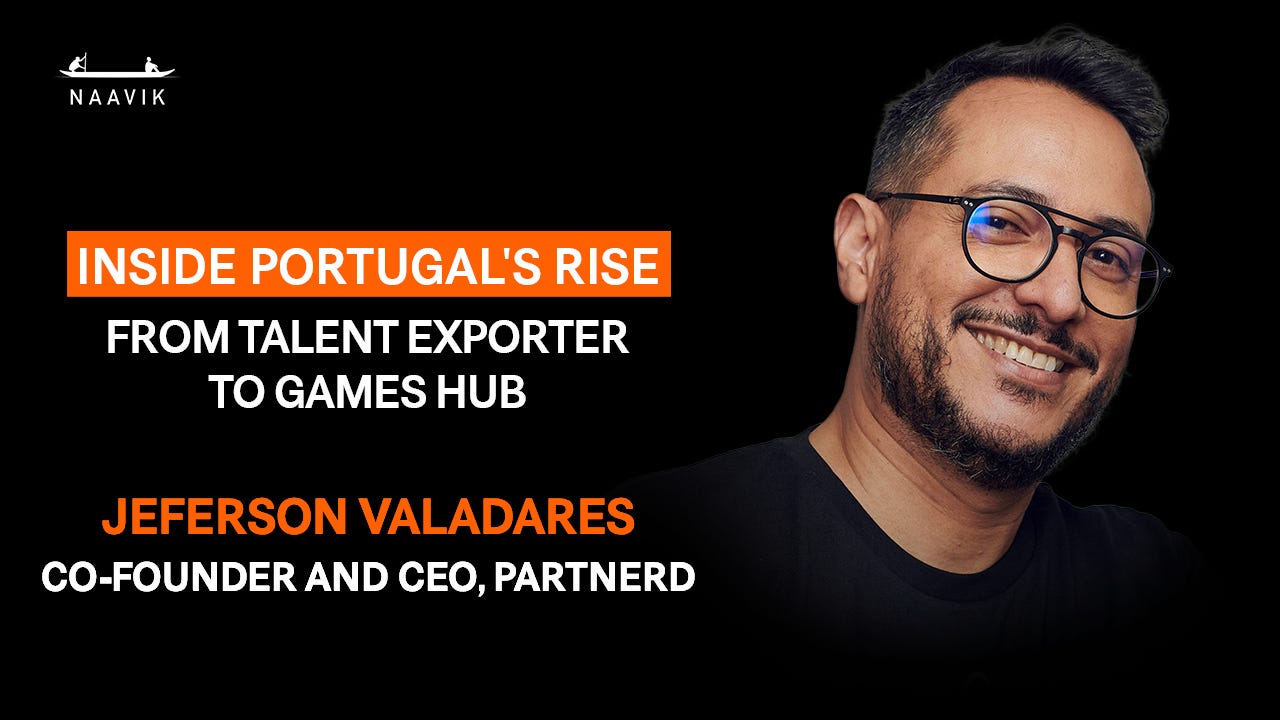
Between 2018 and 2024, the turnover of Portuguese games companies went from around €5M to nearly €100M. In this episode, Kalie Moore sits down with Jefferson Valadares, co-founder and CEO of partNerd and President of the Portuguese Association of Game Development Companies, to unpack whether a country long known for exporting its best talent can become a home for original IP. Jefferson has seen the industry from nearly every seat, as studio GM at EA, executive producer at BioWare, head of mobile at Bandai Namco, and board member at Rovio before its sale to Sega. They explore what the AAA years taught him about when to spend and when to wing it, why big companies keep funding games they already know won’t work, and what he learned running studio acquisitions at Fortis Games about why most deals quietly lose their value.
The conversation also takes a closer look at partNerd, the four-person studio he’s building now, and why they’re making an original co-op game exclusively for Nintendo Switch 2. Jefferson explains the thinking behind designing for asymmetric skill levels so parents, kids, and non-gamers can play together, why GameShare shaped their commercial model, and how hard it is for veteran developers to unlearn best practices and build something genuinely new. He also revisits Doppio, his early bet on voice as a gaming platform, and the timing that led to selling to Fortis in late 2021. Along the way, he lays out the Helsinki parallel he sees playing out in Lisbon, why the hardest gap for emerging ecosystems is product rather than engineering or art, and what he thinks the industry is underestimating about the generation that grew up on Roblox and Minecraft rather than GTA.
Sponsor: What Does a $100 Sale Actually Return to Your Studio?

Most Merchants of Record publish one clean platform fee, usually 4% to 5%. But hiding underneath that fee are FX, payment method fees, money repatriation, chargeback costs, creator code fees, and other costs buried in the fine print. Most studios find out that they receive $87, $85, or even less on a $100 charge, which makes forecasting headcount and marketing spend guesswork.
The Hidden Fees Calculator is free and needs no signup. Enter your annual GMV, average order value, and current provider, and it returns your true effective rate relative to the advertised rate, plus the annual dollar difference. Every rate and fee type is editable; you can compare your specific offer to your provider’s publicly advertised rate.
Built by Tebex, which transitioned its game payment pricing to a single transaction fee with nothing added on top.
Tebex is a direct-to-consumer monetization and webstore platform for game studios and creators, operating as Merchant of Record. Over 14 years, it has processed more than $1.5B in payments and works with studios including Rockstar Games, Take-Two Interactive, MADFINGER Games, Hypixel Studios, and Studio Wildcard.
The Great Mobile Convergence
Written by Jordan Phang, Naavik Contributor and Design Director at Altitude Games
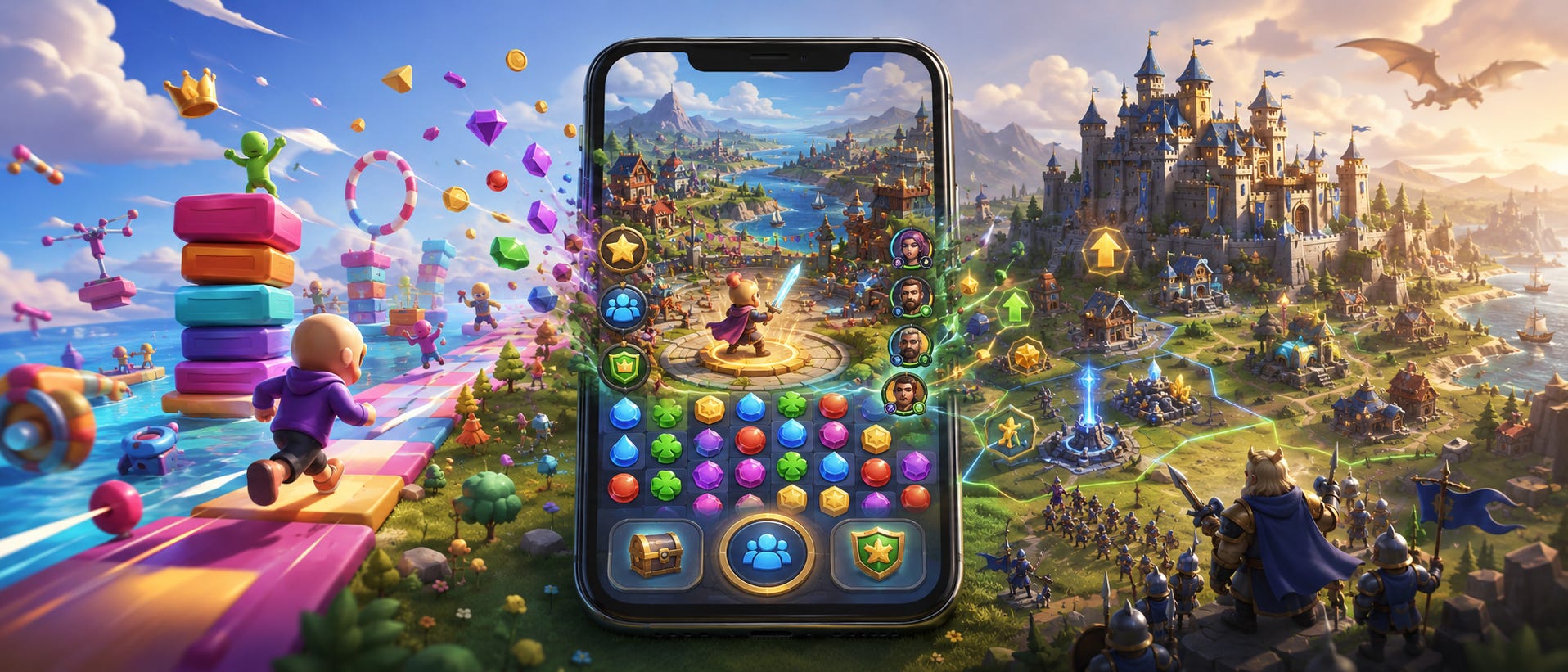
Imagine a day in the life of a modern mobile gamer. They begin by browsing Facebook or Instagram, see a cool card battler that whets their midcore appetite, and they download it. On launch, it’s published by… Voodoo? Later in the day, they’re in the mood for competition. So they join an intense 30-minute PVP tournament in… a match-3. To wrap up their day, they relax by playing a hypercasual simulator… in a 4X.
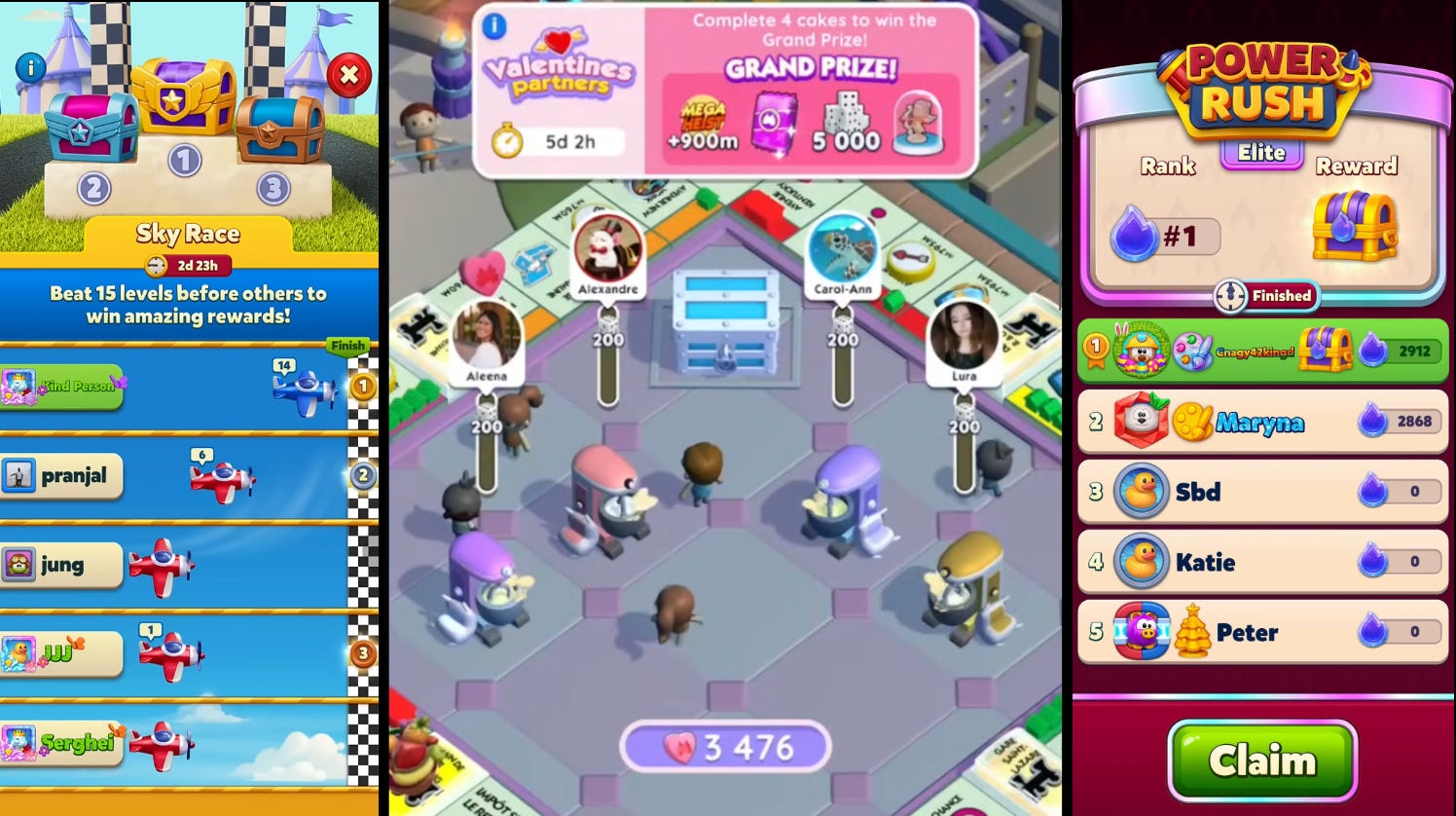
None of this is hypothetical. In fact, you can play Voodoo’s Draft Showdown right now. Then you can enjoy PVP events like Power Rush, Sky Race, and more in Royal Match and Royal Kingdom. Then you can tend to your Hypercasual hospital simulator in Last Asylum.
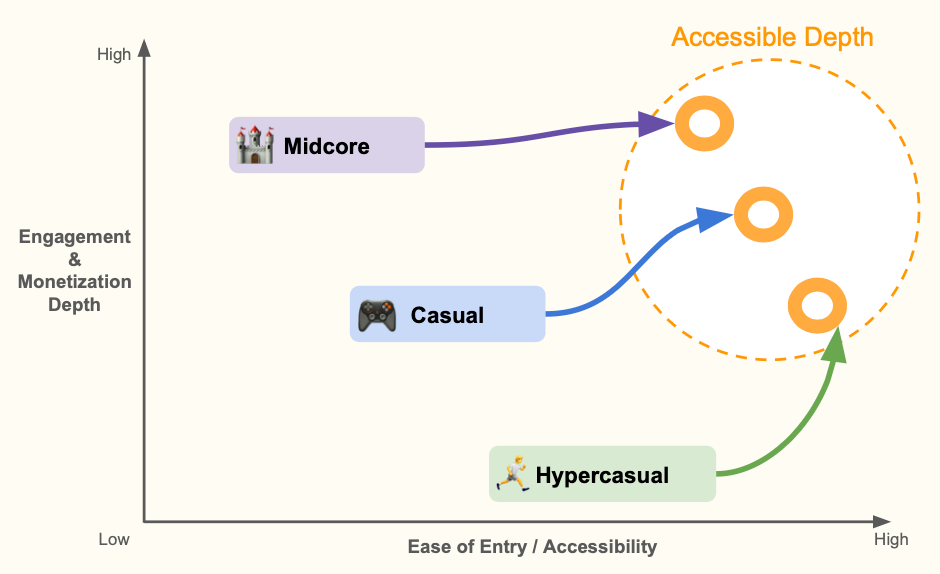
If those examples haven’t made it clear, here’s the lede: mobile games are converging. The boundaries between the traditional product models — Hypercasual, Casual, and Midcore — are breaking down. Features and mechanics that were previously deemed too “core” or too “casual” have and will continue to creep across genre boundaries.
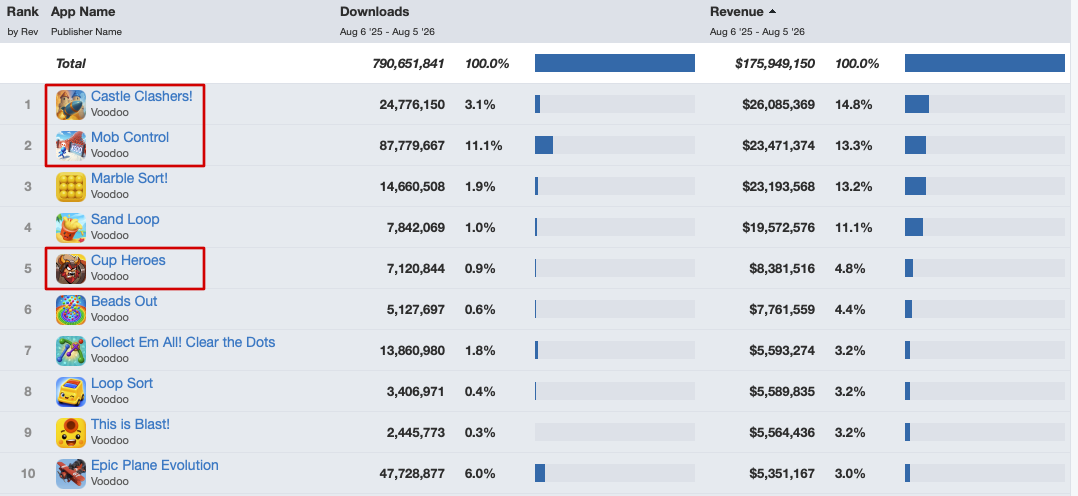
Hypercasual publishers are building toward deeper progression and IAP spending. The table above shows the top 10 games in Voodoo’s portfolio by IAP revenue for the trailing 12 months, showing three Midcore titles accounting for 33% of revenue.
Casual leaders are adding competition, cooperation, and social obligation. Meanwhile, 4X developers are widening their funnels through idle and hypercasual-style onboarding.
Mobile games are increasingly converging around the same objective: combining hypercasual-scale accessibility with midcore-scale retention and monetization, or what we call Accessible Depth.
The reason why? As we wrote in our recent Mobile F2P newsletter, “while mobile gaming can still generate commercially meaningful launches, few become the durable next-generation incumbents.” To succeed in a world where games are competing with an endless array of other media distractions, publishers need products that are easier to acquire, harder to exhaust, and capable of supporting years of engagement and spending.
In this article, we’ll look at three product models — Hypercasual, Casual, and Midcore — examine what publishers have been doing to reach Accessible Depth, and come up with a new formula for success.
Hypercasual
Hypercasual publishers are the masters of reaching a huge audience with appealing and simple mechanics. They are now leveraging this skill set and aiming for deeper and more monetizable genres, distilling the essence to reach a mass market without sacrificing depth. In a sense, they are taking a page from Supercell’s playbook but applying it with an even greater degree of simplification.
Voodoo’s Castle Clashers’ simplistic cartoon graphics belie a deep deck-building system and competitive PVP environment. Homa’s Harvest King condenses tower defense by removing positioning and adding an interesting energy mechanic with its sprinklers.
This strategy isn’t even all that new. Voodoo released Mob Control in 2021. It began as a genuinely Hypercasual game with level-based progression and has since morphed into a full-fledged Midcore-lite experience. We interviewed Miguel Santirso, GM of the Barcelona studio behind the hit, two years ago. Even from its early beginnings, Voodoo already had a long-term vision of what it wanted the game to be. In his words, Voodoo wanted to “make it fun for the long term, and to make it resilient,” and that “Mob Control will be, in two to three years, next to the top Midcore games.”
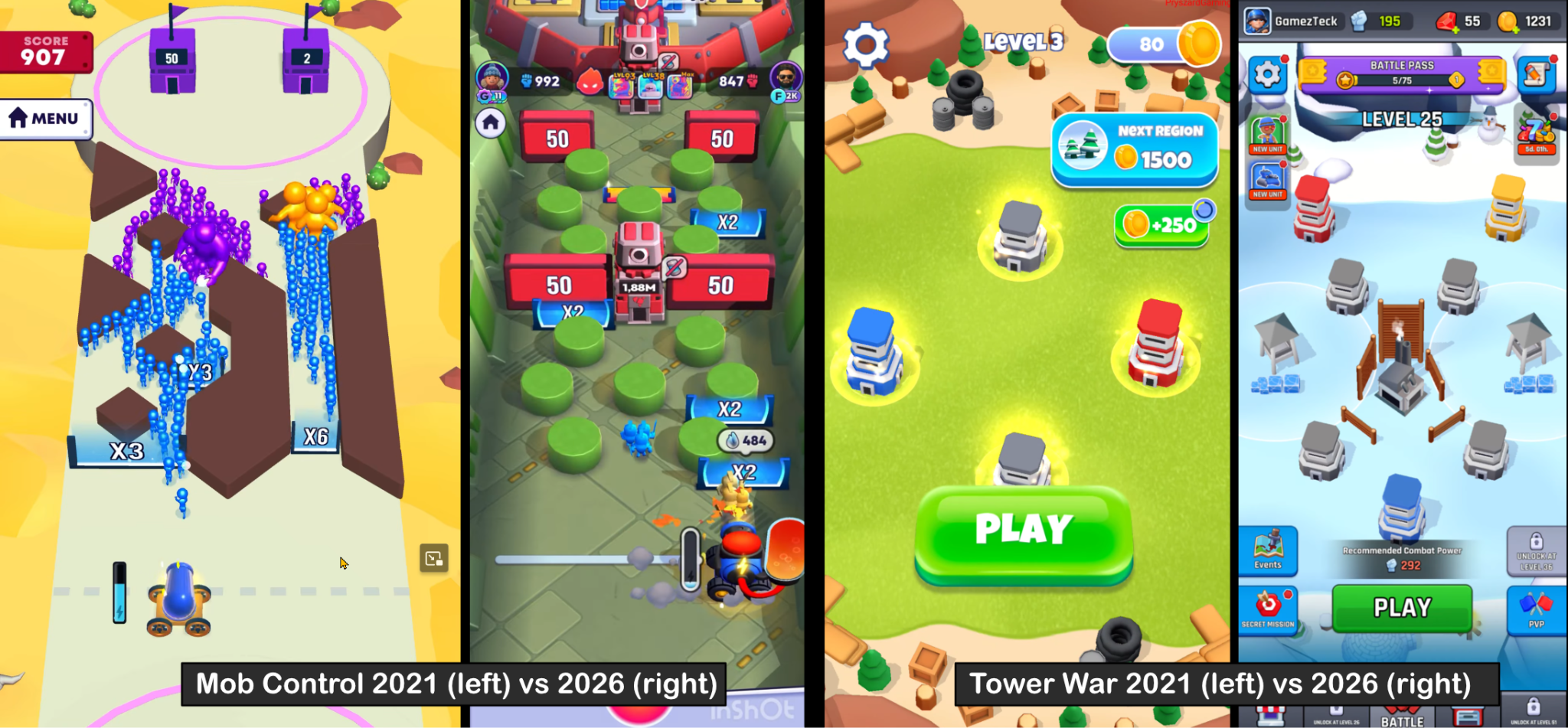
Fellow Hypercasual publisher SayGames has a similar progression with Tower Wars, which was released in 2021 and has slowly evolved into a Midcore-lite experience. It is now SayGames’ biggest game by IAP revenue, with $34M in lifetime revenue. SayGames has also been chasing the Midcore market for a while, and it could be considered one of the pioneers. It published BlackDeck, a CCG that launched all the way back in 2019, making it SayGames’ second-highest game by all-time IAP revenue, at $30M, according to Sensor Tower.
The trend is spreading across Hypercasual. Homa, Tripledot (particularly after it acquired AppLovin’s studios), Azur Game Studios, Rollic, along with others, have either added a midcore-lite title in their portfolios or have incorporated midcore mechanics and monetization like gacha, PVP, ranked modes, deep upgrade systems, and so on.
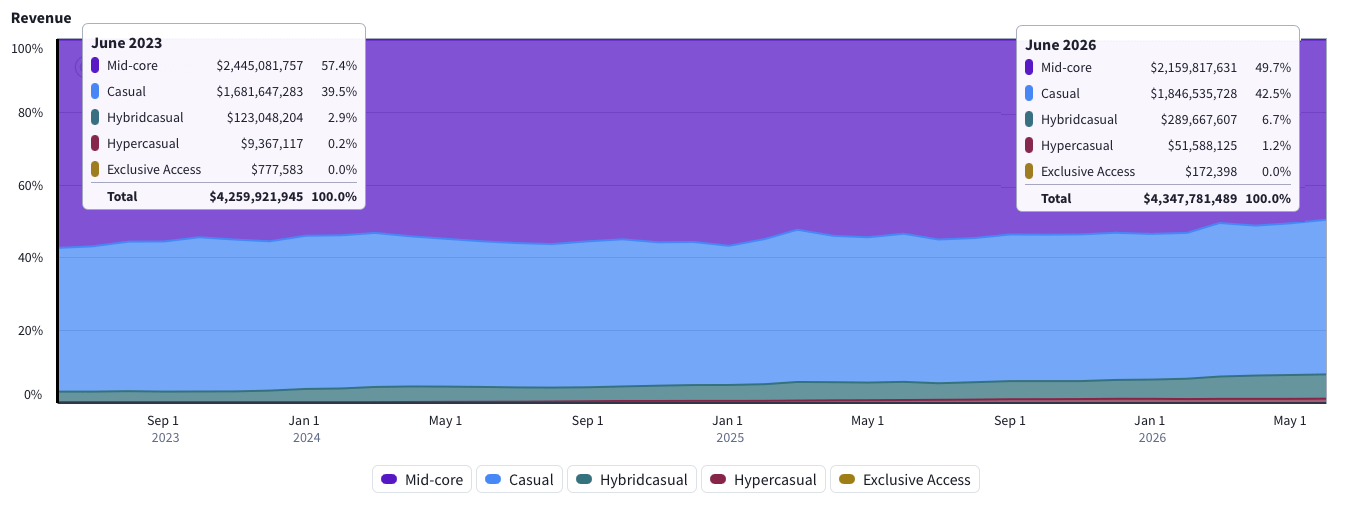
While we cannot attribute this growth entirely to the incorporation of midcore hooks, Hybridcasual and Hypercasual games have increased their share of mobile game revenue from 3.1% to 7.9% over three years, while total game revenue has remained relatively flat.
Casual
Royal Match reset expectations for what a Casual game could be when it eschewed a full-fledged meta for a dense live-ops strategy. Since then, Casual leaders like Dream, Microfun, and Scopely have made competition, cooperation, collections, and social obligation — features that were once the domain of Midcore games — essential to the experience.
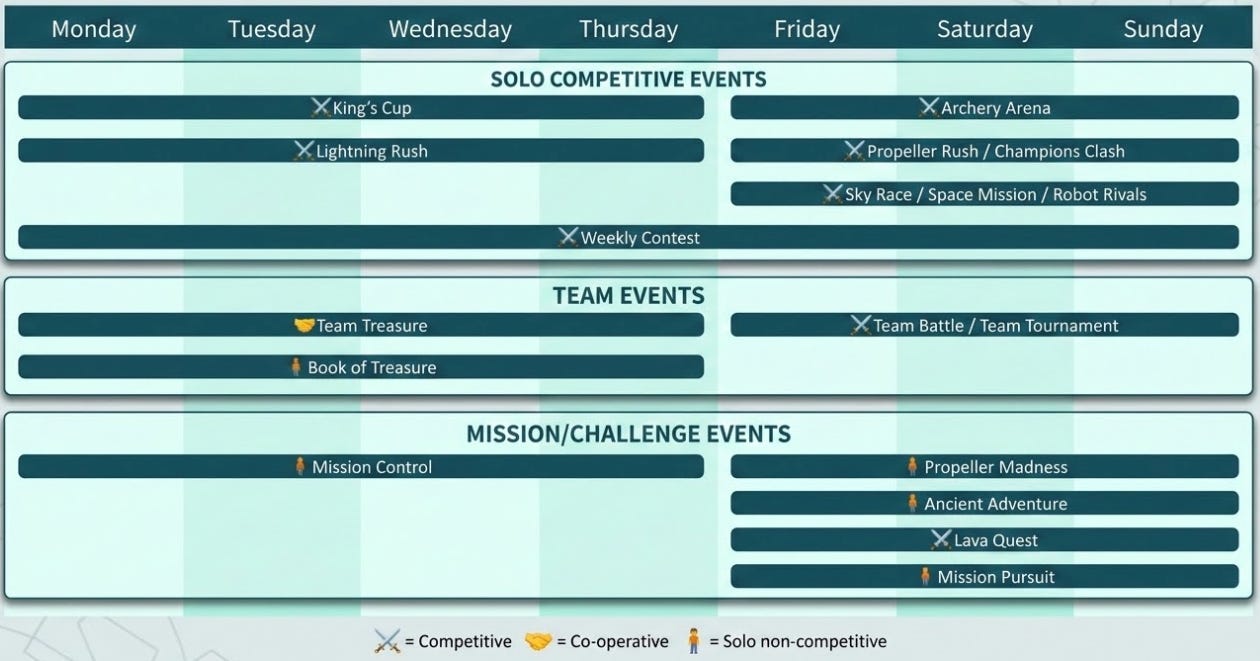
Below is a calendar for the recurring weekly events in Royal Match. Of the 14 events shown here, eight have you competing against other players, and more pointedly, there are at least three competitive events every single day! The other event types target collection (Book of Treasure, Mission Pursuit), social pressure (Team Treasure, Team Battle, Team Tournament), and loss aversion (Lava Quest, Space Mission).
The broader casual games industry took note and did what it does best: follow the leader. Almost every successful casual game now includes some sort of competitive live-ops event, including top casual games like Monopoly Go! and Gossip Harbor.
Besides injecting a bit of that midcore-inspired engagement and monetization pressure, Royal Match, Monopoly Go!, Match Villains, and others took a page from the Hypercasual world where the core gameplay is everything. These games were laser-focused on the core experience, polishing it to the nth degree to make every interaction juicy, snappy, and delightful.
The result was games that were easy to get started, easy to keep playing, and capable of triggering players’ competitive drive — leading to casual games earning more per download than ever before.
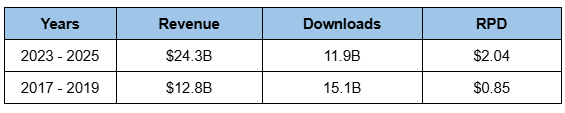
The table above shows Sensor Tower estimates for revenue, downloads, and RPD for casual puzzle games before and after Royal Match (released in 2021), excluding COVID years (2020–2022). We can see that the games post-Royal Match are more revenue-efficient, with RPD 2.4x higher than before. Even after adjusting for inflation, RPD in the post-Royal Match period was 1.9x higher than before.
While the RPD improvement cannot be attributed directly to midcore-inspired engagement systems, it coincides with casual games becoming more revenue-efficient as those systems have grown more prevalent.
Midcore
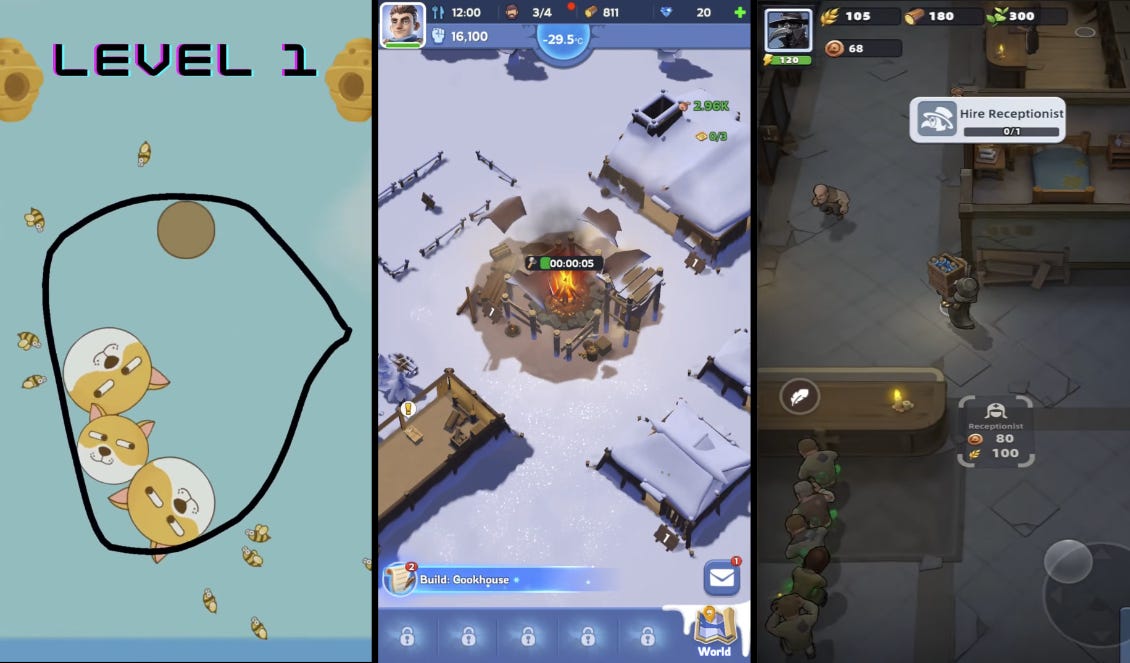
The widening of the 4X funnel by incorporating Hypercasual gameplay has been covered ad nauseum, including in our coverage of Whiteout Survival and Last War, so we’ll be brief. Hypercasual mechanics first appeared in creatives as fake ads, then as disconnected minigames, and increasingly as the genuine onboarding experience. You can play hours of a game like Last Asylum and not realize you’re in a 4X at all.
This strategy allowed Strategy publishers to supercharge UA and widen the funnel, making Strategy the only major Midcore genre to show significant post-COVID revenue growth.
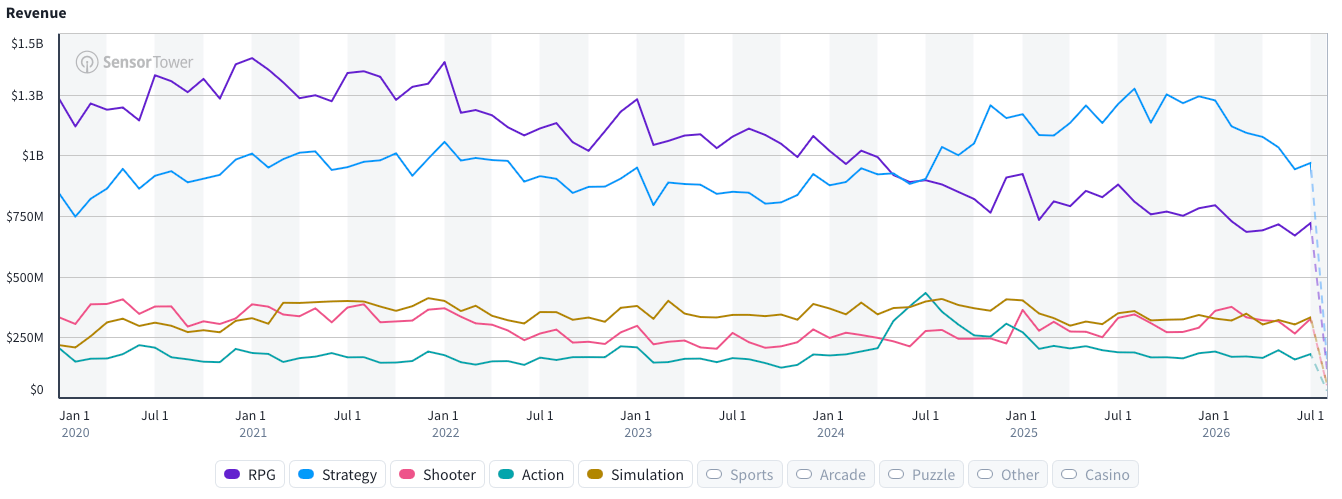
However, as we covered in our recent mobile article on 4X’s UA reckoning, “68% of the top 100 4X games running UA in 2025 recorded YoY declines of at least 10% in their U.S. UA channel impression share.” The hypercasual onboarding trend seems to be faltering, necessitating another evolution for 4X. We previously predicted this could take one of two paths:
Differentiating more strongly from competing 4X titles or finding entirely new audiences to acquire, with differentiation likely the more achievable path.
Extending the value of acquired users through better long-term monetization or retention, with retention remaining one of 4X’s biggest unresolved opportunities.
Our hypothesis is that Midcore could aim for both — incorporating even more hypercasual gameplay to attract new audiences and then implementing the broader live-ops variety and lighter-weight social systems from Casual to give existing players more reasons to stick around beyond the traditional alliance-war loop.
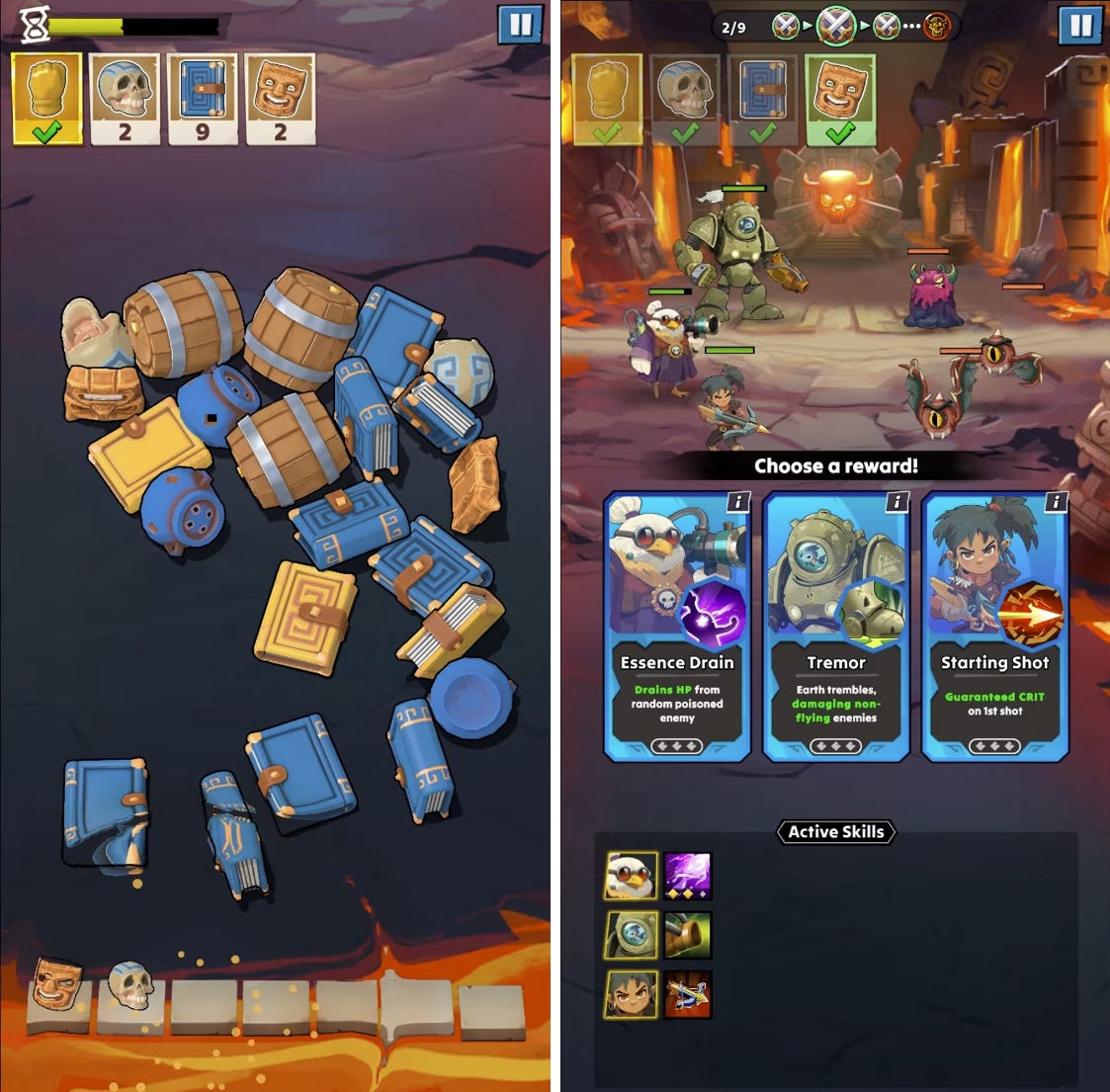
A prototype for this could be the recently released SoulTerra Odyssey, a squad RPG that incorporates the match-3D core gameplay as seen in games like Match Factory. The match-3 mechanic is integrated directly into the RPG combat, with bosses even interacting with the puzzle gameplay to make it more difficult (see this squid boss shoot ink onto the objects, making them harder to match).
Conclusion
There’s a new formula for success, whether you’re making the next Hybridcasual hit, innovating in Merge-2, or placing your bet on a Midcore strategy title.
On the business level, it’s about looking for openings where convergence has not yet happened at scale. What genres and subgenres have one strong piece of the equation — reach, engagement, monetization, or social depth — but weakness in another?
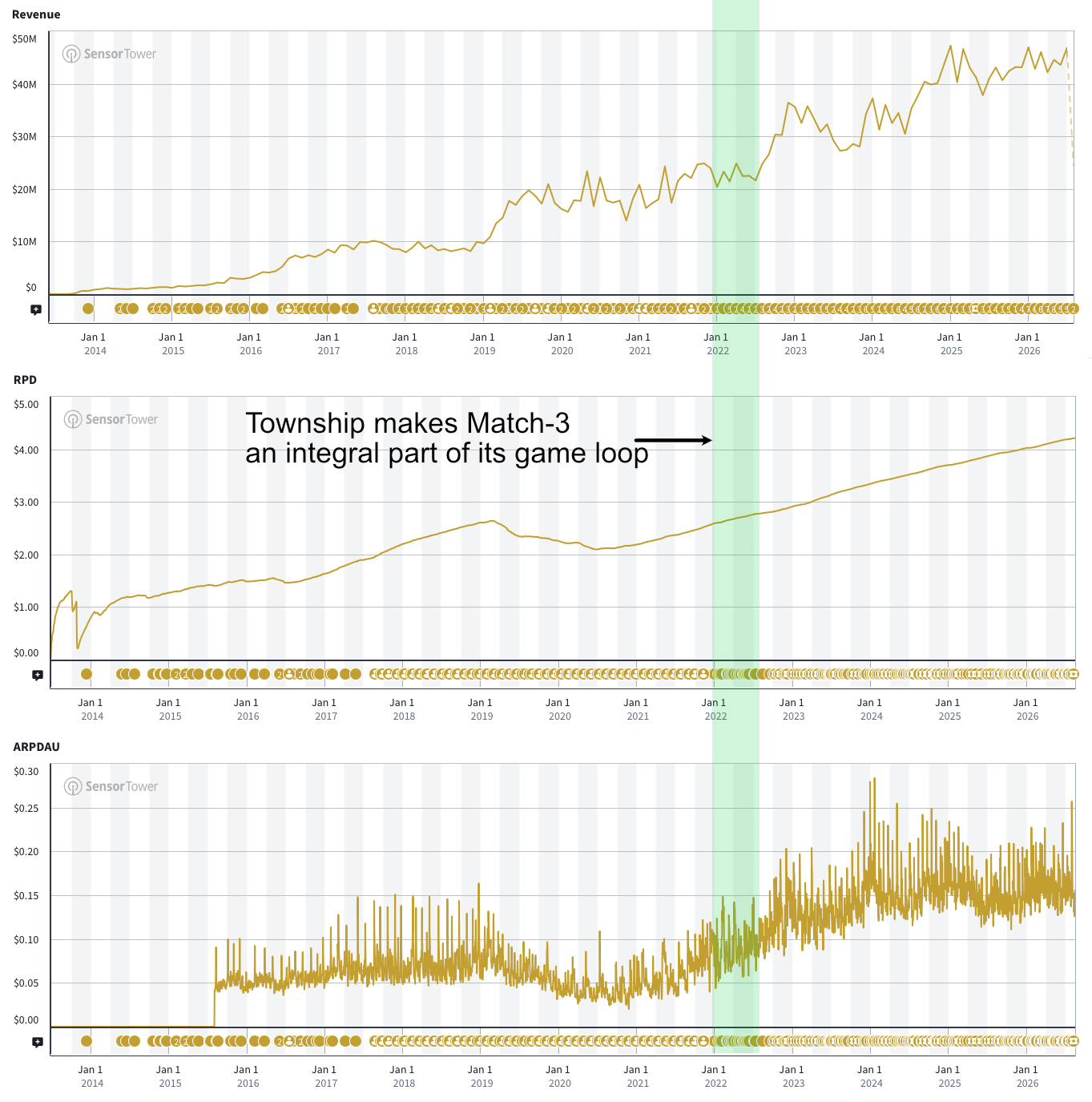
One such genre is Simulation, and we have a prime example of a convergence that has already occurred with Township. Around 2022, Playrix began heavily weaving the match-3 gameplay (which already existed as a minigame) into the game loop. It became the gameplay engine for Township’s live-ops while farming and town-building provided the long-term fantasy and progression. As seen above, that change coincides with Township showing stronger monetization behavior (note that downloads were relatively stable from 2022 onward).
On the product side, it’s about:
Pick-up-and-play onboarding. Get players into actual gameplay immediately instead of interacting with a million “tap here to x” callouts.
Leverage Midcore levers in the meta and/or live-ops — competition, cooperation, social pressure, and loss aversion.
Remove friction without removing challenge or mastery. For example, the simplified deck and drafting mechanics in Draft Showdown still require player agency and decision-making.
You cannot live in a genre silo. Just because you’re working on a match-3 doesn’t mean you don’t need to keep an eye on what’s happening in Hypercasual or 4X. Take the first principles that make those mechanics work in those games and refit them for your game’s context and audience.
As always, the games industry evolves, and we must too. The old product models are outdated. A match-3 game, 4X, and RPG may still feel different moment to moment, but their surrounding product systems increasingly draw from the same playbook.
In Other News
💸 Funding and M&A:
China-based games and AI company Kunlun Wanwei is selling 99% of Beijing Xianlai Huyu to Beijing Xinglan Huyu for $111.2M
US-based AI motion-capture company Kikitora has raised $19.7M
📊 Business & Product:
👾 Miscellaneous:
No gaming experience appeals to more than 26% of players globally
Esports Foundation postpones Esports Nations Cup to November 2027
Save the Children announces its first game and streaming fundraising event called Save Point
PocketGamer.biz Games Industry Region Report on Türkiye’s bustling games industry
Matchmaking platform Sail.game launches free tier for devs ahead of Gamescom
Content Worth Consuming

“As More People Play Games, Even the Tiniest Niches Find a Bigger Audience” — Why Matt Webster Is Convinced People Want Star Wars: Galactic Racer (gamesindustry.biz): “Matt Webster looked set to be a lifer at Electronic Arts. He joined the firm way back in 1990, and spent nearly two decades working at Burnout and Need for Speed maker Criterion, which EA bought in 2004. But in early 2023, along with Criterion alumni Steve Uphill, Pete Lake, Andrei Shires, and Alan McDairmant, he broke away to form the independent UK studio Fuse Games. Now, three and a bit years later, the studio is on the cusp of releasing its first game, Star Wars: Galactic Racer, published by the newly independent Secret Mode.”
Amos Adler: SciPlay’s VP of Growth on Creative Control & the Death Of UA Operators (Unpredictable Hits): “Amit sits down with Amos Adler, VP of Growth at SciPlay, a veteran of one of the biggest social casino portfolios in the world. Operating in a matured, red ocean market, Amos runs growth as something closer to a science than a spend button, and he is sharp about where the real leverage lives. They get into why creative is the only lever you fully control, and how SciPlay built a centralized creative strategy team to stop leaving money on the floor, why attribution is never a one-time decision but a constant hunt for the truth, and where AI is taking mobile UA next: the end of the operator, the rise of the analyst, and a near future where commerce, CPA and IAA run 90% autonomous.”
The Framework We Used at Riot to Build Champions (Building Better Games): “When design, story, and art don’t agree, players feel the friction immediately, even if they can’t put it into words. In this episode, Benjamin Carcich breaks down the DNA Framework (Design, Narrative, Art) developed on the League of Legends champion team. Discover why polishing individual assets won’t fix a disjointed game, how to establish a clear priority stack for your project, and how leaders can maintain true vision cohesion from ideation to launch.”
Three Epic Veterans Are Building an AI-Powered Game Engine to Break the Industry’s Doom Cycle (gamesindustry.biz): “Unity and Unreal have dominated the development scene for a long time now, and were used to make roughly 70% of the games released on Steam in 2025. Godot has seen some significant growth in the past few years, and many big companies still favour proprietary engines – like Capcom with its RE Engine – but otherwise, Unity and Unreal have got the game engine market sewn up. Yet Arjan Brussee, Sjoerd De Jong, and Michal Valient, the founders of Immens, think there is room for a new engine on the scene – and room for improvement. The industry veterans’ CVs cover an impressive range of big-name companies, including Unreal maker Epic Games, Guerrilla Games, Boss Key, and Apple, and the trio are ready to challenge the industry titans.”
Arkane Veterans Harvey Smith and Ben Horne Reunite: “We’re Going Back to the Games We Love” (The Game Business): “The Game Business' Christopher Dring chats with legendary immersive sim game maker Harvey Smith (Dishonored/Deus Ex) and executive producer Ben Horne (NBA/Redfall) to discuss their new studio Black Pony Immersive. The three discuss whether the 'immersive sim' is dead, lessons from Redfall, building a new studio in 2026, being positive in the face of a continued misery and a whole lot more.”
The 2026 D2C Survey: Why 41% of Studios Still DON’T Have a Web Store (and Why They’re Wrong) (two & a half gamers): “Matej Lančarič, Jakub Remiar, and Felix Braberg welcome back Chip Thurston (FastSpring) for the sixth D2C episode — a full breakdown of FastSpring's 2026 D2C survey (Q2 2026, 110 respondents, all senior manager or above, 92% from 100+ person studios, 91% doing over $10M/year, split across US/Europe and casual/core). They unpack why web-store adoption barely moved year-over-year (57%→59%) despite 60% planning it — game dev is hard and roadmaps slip — and the three "reasons not to adopt," which Chip reframes as misconceptions: technical complexity (rooted in confusing a merchant of record like FastSpring with a payment service provider like Stripe — the MoR handles all the tax, compliance, and audit exposure for you), damaging Apple/Google relationships (a fear anchored in 2023, when there were real repercussions; in 2026 both platforms have defined, approved D2C compliance paths), and legal uncertainty (the terms are actually solidifying — Epic/Google settling, Apple's Japan/Brazil compliance as the bellwether).”
More About Naavik
Naavik’s team of experts has helped over 300 companies — publishers, studios, tech companies, and investors — succeed across the video game industry. We’d love to work with you too! Here’s how we can help, spanning all platforms, genres, and regions:
Strategy Consulting: Market research, corporate strategy, game and economy design, gamification, live-ops strategy, AI strategy, product management, brand and performance marketing, and more.
M&A and Investment Advisory: Expert commercial due diligence for buyers, fundraising support for sellers, and fractional CFO/CSO services.
Fractional Talent: The one-stop shop for top-tier fractional talent covering dozens of game industry roles — analytics, design, marketing, art, QA, and more.
Check out the links above to learn more. If you'd like to discuss how Naavik can support your team, click the box below or send us a note at consulting@naavik.co.