
Steam Next Fest's AI Problems
What is Steam Next Fest's relevance, and where does AI-enabled content actually stand today?
Hi everyone!
Over the past weeks, Naavik covered the fast-growing microdramas category. If you’re paying attention to this space, we recommend checking out our podcast discussing AI-native production with Angela Yu, co-founder of Storeel, as well as our in-depth article overview.
As always, Naavik’s strategy consulting, M&A advisory, and fractional talent teams are here to help your business. Reach out to learn more.
Onto this week’s article, let’s dive into the AI chatter around Steam Next Fest.
Sponsor: Create Next Generation Game Experiences with AWS

AWS for Games gives you everything you need to build, run, and grow innovative gaming experiences. Leaders across the gaming industry rely on AWS’s more than 16 years of games expertise to launch and run some of the world’s biggest games, including Fortnite, Roblox, and League of Legends.
AWS and over 300 AWS Games Partners offer the broadest and deepest set of purpose-built services and pre-built solutions for cloud game development, content creation, game backend and infrastructure, player acquisition, retention, and monetization. These tools empower game developers to build healthy global player communities, gain player insights, personalize, and monetize player experiences, to build lifelong fans. 750 million gamers each month, around the world, play games built on AWS.
Learn how AWS can help you build, run, and grow innovative gaming experiences.
Steam Next Fest’s AI Problems
Written by Francois Courset, Lead Consultant at Naavik
The June 2026 edition of Steam Next Fest closed out two weeks ago and was by far the biggest yet: over 4,300 demos for upcoming PC titles, with games like Mistfall Hunter, Echoes of Aincrad, and XenoFeels standing out as the event’s clearest breakout hits. What defined this edition, however, was the volume and intensity of criticism surrounding AI’s role in game development.
Because Steam Next Fest is an open window on what the PC landscape will look like for months to come, it’s also one of the clearest available signals for tracking AI adoption and consumer reception at scale. We wanted to zoom out on the event and assess its relevance when barriers to development are diminishing, unpack how studios should be reading the current backlash, and finally, use our results to map where AI-enabled content actually stands today.
Discoverability Challenge in an Increasingly Crowded Event
A quick primer on Steam Next Fest: It is Valve’s flagship demo showcase, giving players free and direct access to hundreds of unreleased titles. Launched in 2019 as the Steam Game Festival, the event now runs three times a year — in February, June, and October — with the June 2026 edition taking place June 15–22. Participation is limited to games with a Steamworks account in good standing, a functioning demo ready at launch, and a release date scheduled after the Fest wraps, with one-and-done eligibility per title. Over the years, it became a key beat for PC developers to collect early feedback, accumulate wishlists, and build pre-launch momentum.
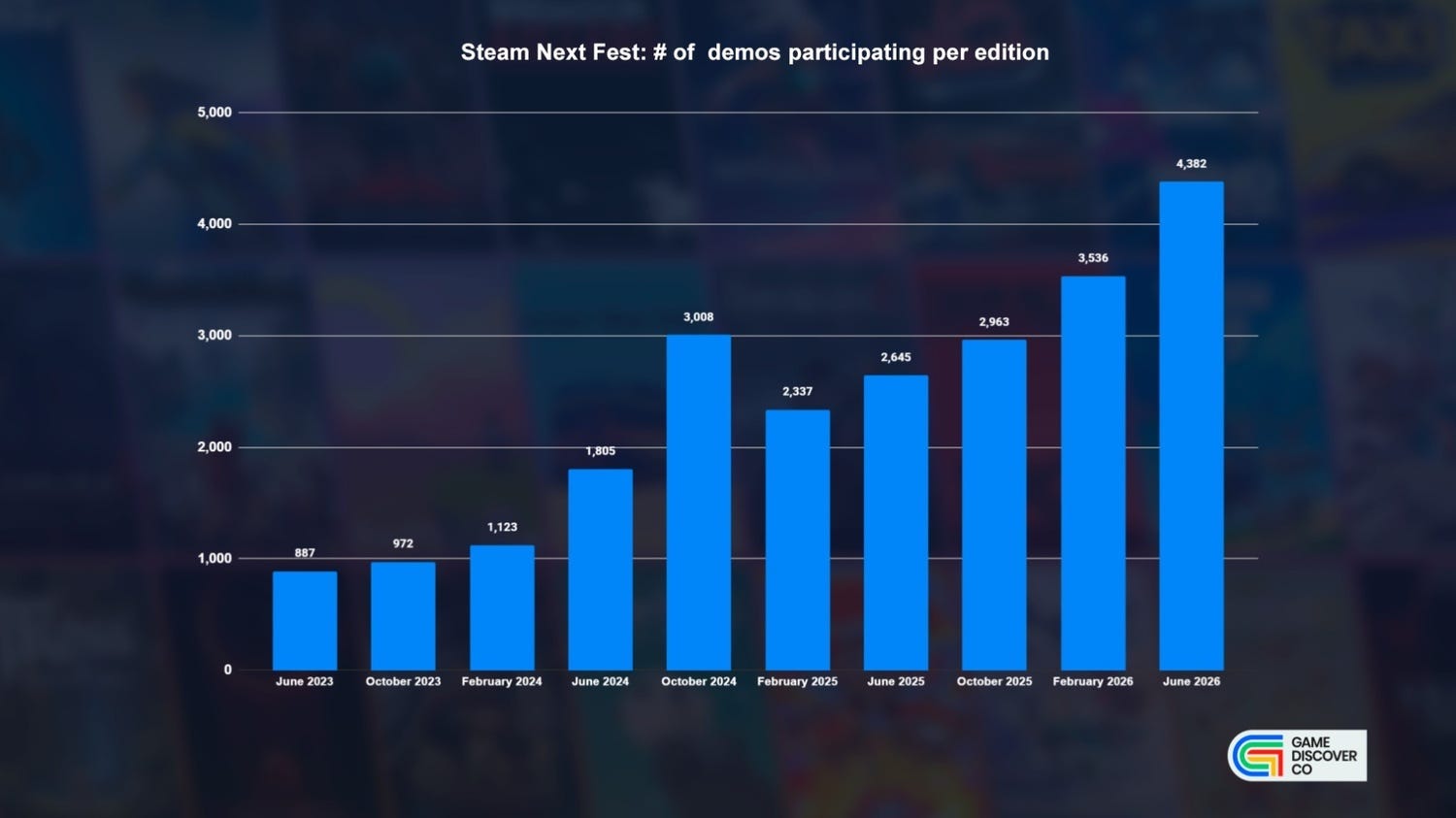
Steam Next Fest just hosted its biggest edition yet: 4,300+ entries, a 24% jump from February and 66% growth YoY. The surge tracks the event’s well-established value for developer visibility, but it’s really a downstream effect of Steam’s expanding catalog, with new releases up 19% YoY in H1 2026 per Video Game Insights. AI has been a widely documented accelerator here. AI-tagged releases (a self-declared field) have climbed to as much as 40% of new titles in the most recent months, a direct consequence of AI tools lowering the barrier to entry for developers.
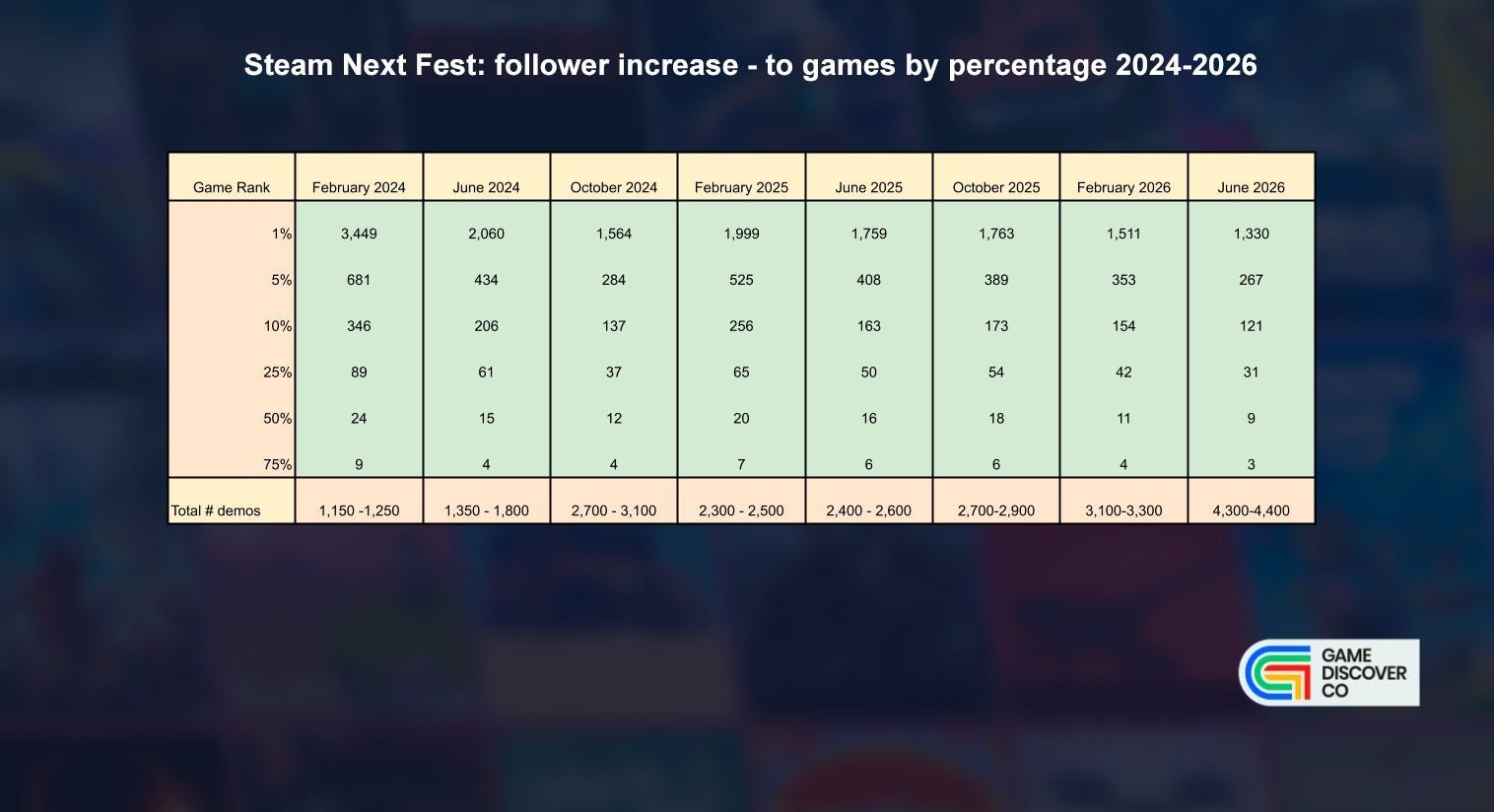
Attention at Steam Next Fest is increasingly becoming a zero-sum game. While the participant pool spikes, aggregate followers have increased just 7% from the last edition and 22% YoY, nowhere near enough to keep pace with the growth in new games. The result is smaller gains for individual games, as reported in Gamediscover.co’s extensive breakdown: top 10% performers added +121 followers (down ~25% from +163 in June 2025), and top 1% performers added +1,330 (down ~25% from +1,759). This means fewer breakout hits driven by the event, and instead more attention focused on games that had already built momentum through separate marketing initiatives.
Steam Next Fest is a live case study in the discoverability dynamics we unpacked in our Distribution in the Age of AI piece: too much content, not enough platform-level curation to sort it. Valve's slow pace of adaptation shifts the burden onto developers. Explosive submission growth is eroding Next Fest’s value as a standalone play while boosting the appeal of tightly curated alternatives, hence the rise of showcases like Evil Empire’s III initiative. Algorithmic placement alone no longer moves the needle. Winning now requires building an audience before the demo drops and focusing budget behind channels outside Steam’s oversaturated surface — press, influencers, community. Smaller teams without the budget to run that kind of funnel will find breakout outcomes harder to reach.
Navigating Gamers’ Concerns Over AI Adoption
In parallel, the event was marked by consumer resentment around AI disclosures, which sparked review-bomb campaigns further reinforced by media narratives. Industry leaders are now staking out public positions against Steam’s AI labeling push, while a growing (if still niche) contingent of players has turned to browser extensions built specifically to filter AI-tagged games.
So what exactly happened? Of the 4,382 demos featured during the event, 550 — or 12.5% — disclosed some use of AI in their production, a self-reported figure that likely understates true usage. That’s a far cry from the 20% number that made headlines, which actually referred to submissions. It suggests that Steam’s eligibility barriers are doing a good job of filtering the pure AI slop content.
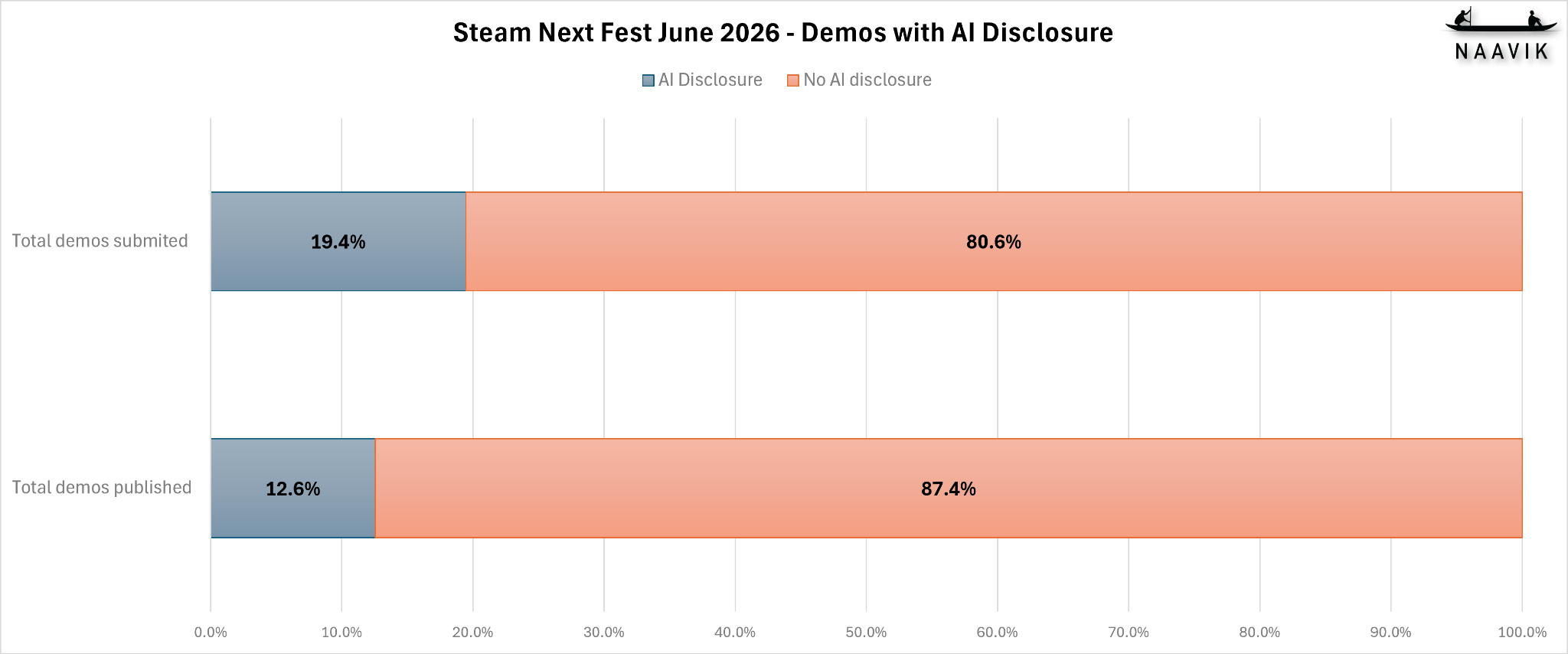
The backlash, however, clustered around developers concealing AI use (such as 1666: Amsterdam). Several of the event’s top-performing demos disclosed their AI usage upfront and performed just fine. Six out of the top 25 games by wishlist growth had the AI disclosure.
This isn’t the first time an innovation has been branded anti-player. Microtransactions took close to a decade to go from pariah to standard practice on PC and console. We are clearly standing in a transition phase, and it’s on developers to thread the needle between production pressures and audience sentiment. Specific geos, such as Asian markets, have already achieved smoother consumer adoption.
A sticking point, however, is Valve’s tagging system, which treats wildly different AI use cases as a single undifferentiated category, artificially splitting the market into “AI” and “No AI” camps. A study by Ross Burton provides empirical evidence that the Steam AI tag correlates with weaker performance. This creates a fundamentally flawed incentive structure rewarding silence over transparency. It is clear Valve’s current system either needs to be radically revised or removed entirely.
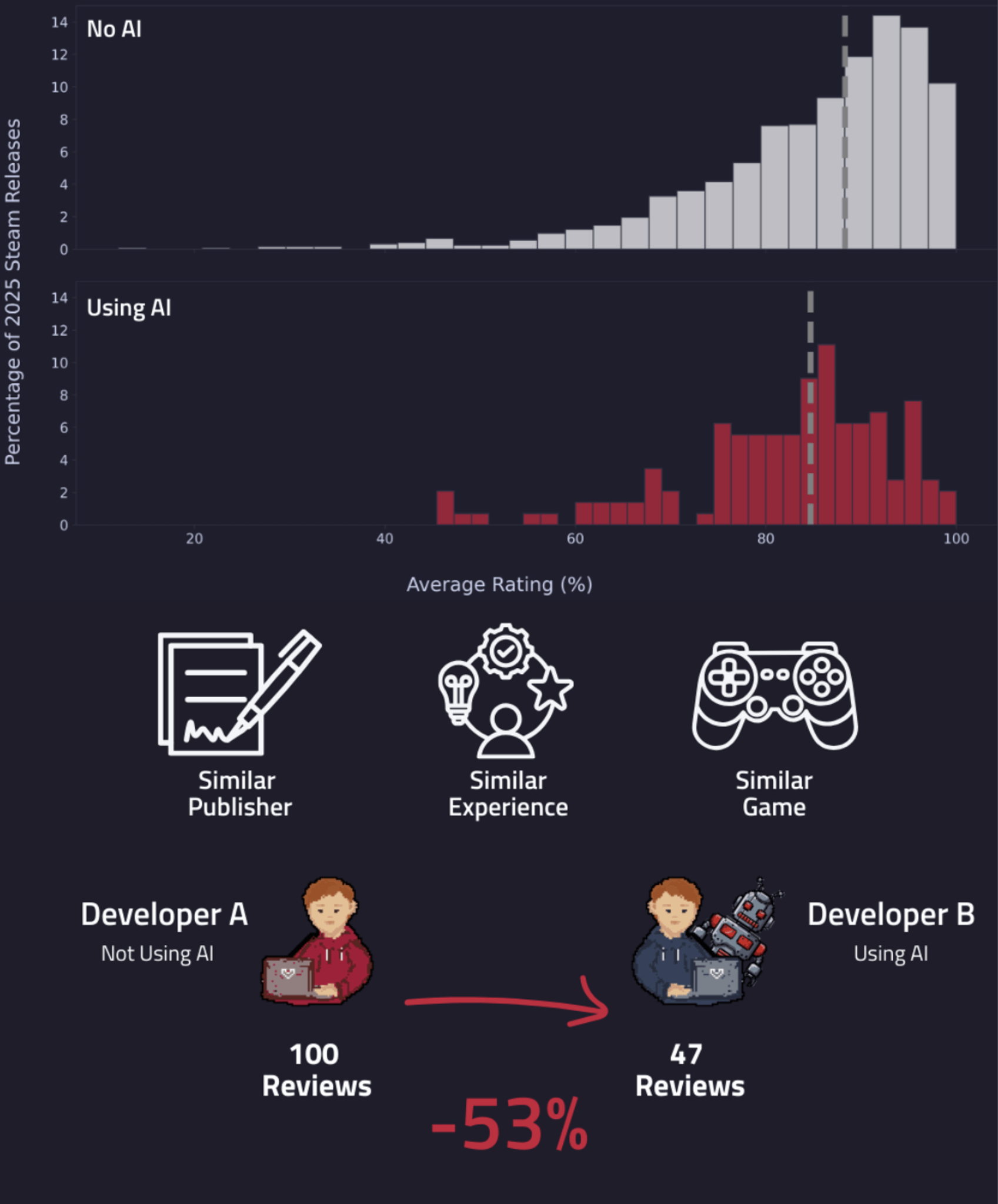
Consumer resentment around AI is unavoidable simply because the loudest critics are also the most engaged gamers, the ones who drive initial word of mouth. The 1666: Amsterdam case makes clear that hiding is not a proper option, and developers might still underestimate the risks. To that end, the first step is proper governance: auditing use cases, vetting vendors, and setting disclosure rules before a title reaches Steam. The second step is communication: leaning into Steam’s disclosure field honestly while getting ahead of backlash, much like SIE has done by publicly contextualizing its own AI usage. As Steam Next Fest’s results show, some demos disclosing AI still met performance expectations, which suggests AI is frequently used as an argument for a game’s other shortcomings, while quality remains, as ever, the deciding factor for consumers.
Where Are AI-enabled Games?
The most notable absence in this edition of the Next Fest was AI-enabled games, meaning games that use generative AI as a core gameplay component — through AI NPCs, live content generation, or prompt-based interactions. None of the top 50 Steam Next Fest games by wishlist increase featured an AI-enabled gameplay component, and these types of experiences are barely part of the conversation.
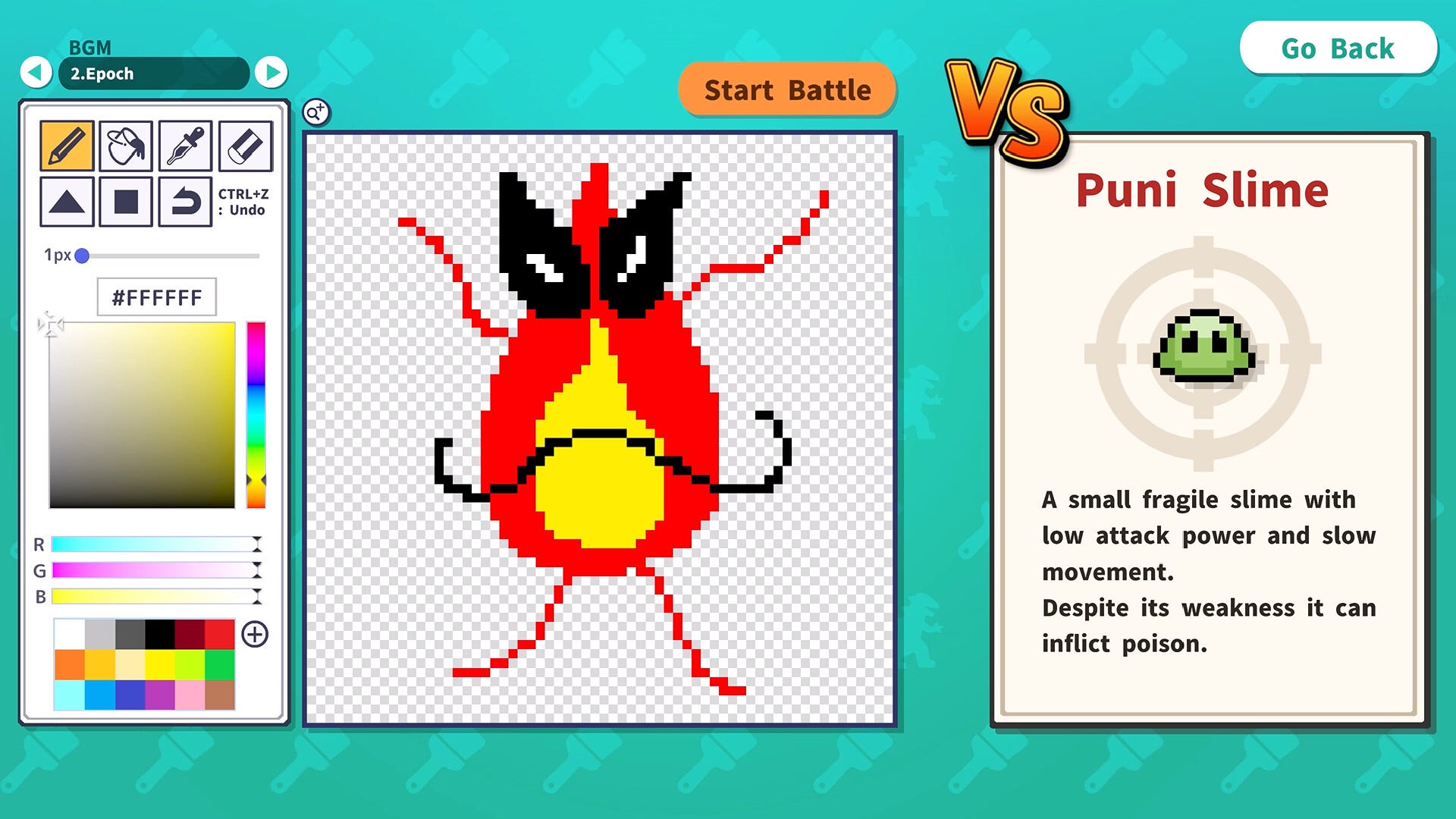
It’s worth caveating this statement: Next Fest audiences aren’t especially AI-friendly right now, and running inference for free against a week of unpredictable, high-volume traffic is a rough economic bet. The issue is also largely PC-specific, as we’ve previously noted how the mobile ecosystem was quicker to iterate around AI usage. Still, a small pocket of demos experimented with AI-native mechanics, even if none broke out of niche territory. AI Pixel Battle, for instance, has players draw a monster tough enough to outmatch the opponent’s, then hands judgment to an AI that narrates the battle in real time.
We are still quite early in the generative AI cycle. It’s been less than 4 years since ChatGPT launched, and it takes time for specific tooling to be built, for companies to adopt it, and then to ultimately ship years later. Teams still often have to create their own tech, as no out-of-the-box AI tools exist flexibly at scale yet for gameplay-related use cases. Next Fest gives a glimpse into the near future, but is not fully representative of anything more distant. It isn’t leading to unique AI breakouts yet (and isn’t designed to), and it will just take more time to get to that point. We’ll just have to see how long it takes.
Looking at recent announcements from Krafton and Mihoyo, we could be witnessing an evolution where AI-gameplay innovation is pushed from the top, instead of emerging from startups that typically have more room to innovate but have to rely on available off-the-shelf solutions. By nature, AI technology can be complex to integrate and maintain in player-facing experiences. It requires specialized expertise, extra infrastructure, continuous tuning, and strong pipelines for data, testing, and model maintenance. At the same time, the economics of inference costs haven’t been fully solved.
What we’re witnessing right now is AAA publishers with enough runway to innovate going to market through measured innovation as optional aspects in already live games, while more experimental takes are either still largely in the proof-of-concept stage or live within isolated ecosystems like the web or Discord. Looking ahead, it’s genuinely hard to say where the next AI-enabled hit will emerge from, and we’ll be watching this space closely as it develops. In the meantime, even the first steps toward production-grade AI adoption remain genuinely difficult within PC. As the broader ecosystem transitions toward wider adoption, a fair amount of consumer education will be needed to bring players along, especially in the West.
Top News Items
Written by Devin Becker, Consultant at Naavik
Godot Bans "Autonomous AI Agent Use or Vibe Coded" Contributions
The Godot Foundation announced policy updates banning nearly all AI-generated code contributions to the open-source game engine. The updated rules prohibit autonomous AI agent use or "vibe coding" — using AI to generate substantial portions of code — as well as AI-generated text in human-to-human communication, such as pull request discussions. Minor AI assistance for tasks like code completion, regex, or find-and-replace remains acceptable, but contributors who use AI to help author code must disclose it. The foundation’s reasoning is blunt: AI-generated contributions have been increasing, and they are “demoralizing” for the volunteer maintainers who review them. Godot wants all contributions made by humans who can “take responsibility for their code,” and heavy AI users often won’t do that.
This is an important line drawn by a major engine project, and it matters because Godot’s open-source codebase depends entirely on volunteer goodwill. If maintainers burn out fielding low-quality AI submissions, the engine suffers. The policy highlights a growing philosophical split in game engines as commercial engines like Unity and Unreal are racing to embed AI deeper into their workflows. Godot’s bet is that human accountability produces better infrastructure code, while the commercial engines bet that AI acceleration is an unavoidable competitive advantage. It’s important to note that Godot isn’t preventing developers from using AI coding tools on their own projects, only preventing contributors from submitting that code back to the engine. This stance may also appeal to developers who have previously considered Godot when alienated by Unity’s past policy changes, but it could also lead to an increased feature gap over time.
General Intuition Raises $320M for AI Frontier Models Based on Gameplay
General Intuition, a sister company to gaming clip platform Medal, raised $320M at a $2.3B valuation to build AI frontier models trained on gameplay data. The pitch is that games generate uniquely valuable spatial and temporal reasoning data that can train AI models to perceive, predict, and act in any environment, including controlling real-world robots. The company builds models that predict actions, like the decisions players make inside video games. Medal’s 17M+ monthly active players provide the raw data, and the company has already transferred its learnings into real-world robotics faster than expected.
The strategic significance lies in gaming data being valued as foundational training material for general-purpose AI. If General Intuition’s approach works, game data becomes an important upstream input for the broader AI economy. Spatial data from other companies, like Niantic, has already proven interesting to AI companies, and any potential revenue source for games is worth considering in today’s constrained environment. For more on General Intuition’s approach, listen to our interview with Pim de Witte here.
Kinoa Raises $10M to Unlock Mobile App Revenue Using AI
Kinoa raised $10M to support its suite of AI predictive models for mobile app operations. Founded by veterans of Playtika, Amazon, and Skai, the platform uses predictive AI agents to anticipate which users will churn, become high spenders, and which offers to surface at the right moment. It then acts on those predictions automatically without requiring code releases. The company claims it consistently delivers over 25% revenue lift across its customer base, which includes Playstudios, Playsimple, and MTG. The pitch is particularly timely given that mobile user acquisition costs have increased while targeting efficiency has declined, squeezing the economics that mobile publishers have relied on for years.
While most AI conversation in the games industry centers on content creation (generating art, code, or narrative), Kinoa targets the operations layer — live ops, monetization, and retention. This is an area where AI can deliver fast and measurable ROI because the feedback loops are tight and the outcomes are directly tied to revenue. If tools like Kinoa prove out at scale, they can allow small mobile teams to run personalization programs that previously required a large dedicated live ops staff. Such tools can also boost the efforts of larger teams, although they may potentially compete with legacy in-house tools.
Savvy Games Group Teams with Genvid to Bring AI Tools and Training to Saudi Arabia
Saudi Arabia’s Savvy Games Group signed a memorandum of understanding with Genvid Holdings and Massive Studios to bring AI-powered development tools, training programs, and mentorship to Saudi-based game studios, indie developers, and universities. The deal focuses on Savvy’s incubator efforts and job creation within the kingdom, not on Savvy’s larger portfolio companies like Scopely or ESL FACEIT. Genvid will provide its enterprise AI workflow platform, which includes provenance tracking that can verify the origin of generated assets for copyright compliance, and it will run master classes teaching local developers how to build cutscenes, assets, and trailers using AI. Massive Studios will contribute its AI-native production capabilities for visual storytelling.
Genvid CEO Jacob Navok argues that AI game tools may take off outside the United States first. He pointed to the absence of anti-AI labor pushback in regions like Saudi Arabia, India, and Southeast Asia, and noted that these markets have access to inexpensive labor that can be combined with inexpensive AI tooling to produce content at scale. Saudi Arabia’s Vision 2030 initiative pushes building a domestic games workforce quickly, and AI tools can compress the learning curve for developers who lack the decades of institutional knowledge that established Western studios have accumulated. If the approach works, it could become a template for other emerging game ecosystems and a competitive pressure on established studios that are slower to adopt these same tools.
EA: AI Is Delivering "Faster Prototyping" and a "Real Rise in Creativity" in Its Studios
During Summer Game Fest, EA’s president of enterprise development Laura Miele said AI tools are producing tangible benefits inside EA’s studios, including faster prototyping, reduced tedium in developer workflows, and what she described as a genuine increase in creative output. She did not cite specific examples but positioned AI as a friction-removal layer for pipelines and tools rather than a replacement for creative labor. This follows EA’s 2025 directive urging nearly 15,000 employees to lean on AI for tasks ranging from code generation and concept art to management workflows, and QA automation. Back in 2024, CEO Andrew Wilson estimated that more than 50% of EA’s development processes could be positively impacted by generative AI.
Miele’s comments are notable less for what they say and more for what they don’t. No shipped titles were referenced, no metrics were shared, and the specific types of AI being used were left undefined. There is a wide gap between AI-powered project management tools and generative AI content creation, and Miele’s remarks did not distinguish between the two. That vagueness is a pattern across major publishers where executives signal enthusiasm while the actual integration remains opaque. The real test will be whether EA’s upcoming slate (Battlefield, sports titles, and any new IP) visibly reflects these gains. Until concrete results ship, these statements read more as positioning for investors and the pending Saudi acquisition than as evidence of a creative transformation. However, if the results do materialize, it will likely further accelerate the adoption of AI tools in larger publishers.
Other News Items
Tripo AI raises $150M for GenAI tools for gaming — a month after its previous $200M raise
Vampire Survivors dev ‘reviewing’ Fortnite collab after Epic’s AI announcement
Netflix is using an AI-generated Gene Wilder voice in its Willy Wonka reality show
NexTide Media launches AI tool to glean audience insights from livestreamed video
Content Worth Consuming
Epic’s Sweeney claims Steam AI labels are ‘really irresponsible of Valve’ (GamesIndustry.biz): “I think it’s really irresponsible of Valve. They shouldn’t do it, because it makes it much, much, much harder for a game developer to have a chance of success. You have to choose from either not using tools that can make you way more productive, and probably failing due to competition that does.”
How Tencent sees AI and UGC lowering game dev costs and leading to new kinds of games (Gamesbeat): “Look, at the end of the day, I know in the West there’s a lot of resistance in the gaming industry in terms of thinking about what AI means for the industry as a whole. In terms of labor and everything like that. Working for Tencent, I think you know Tencent’s a very practical company as well. When I went back to Shenzhen a few months ago, management talked a lot about AI first across all of the business.”
AI Native Games: A Survey and Roadmap (Zhongguancun Institute of Artificial Intelligence): “Generative AI now enables games to produce dialogue, quests, characters, images, and worlds at runtime. Yet generation alone does not make a game AI-native, nor does it guarantee playability. This paper defines AI-native games by whether runtime generative AI is constitutive of the core loop: if the AI component were removed or trivially replaced, the central form of play would collapse or become fundamentally different. This counterfactual criterion separates AI-native games from AI-augmented games, boundary artifacts, chatbots, tavern-style roleplay, procedural content generation, and AI-assisted production. Using this definition, we screen candidate artifacts and analyze 53 publicly available AI-native games and prototypes.”
I Gave an AI a Civilization to Run. It Built a Nuke (Liam Wilkinson): “I gave an AI a civilisation to run. By the midgame it was winning: a trade network that dominated the map, alliances on every border, a diplomatic victory within reach. It had outbuilt, outearned, and outmanoeuvred every rival on the board. What it hadn’t noticed was France. Quietly, across a hundred turns, French culture had been seeping into every city on the map. By the time the agent recognised the threat, the tourism was so deeply embedded there was no peaceful way to stop it. Every counter it reached for was broken. Every tool it had built to respond failed. It had one option left. It built two nuclear devices and levelled Toulouse.”
MIRA: Multiplayer Interactive World Models with Representation Autoencoders (General Intuition & Kyutai): “Simulating video games is therefore a stepping stone to physical AI: it's a setting where data is abundant and it's cleaner than real-world videos since it's generated by a game engine. But learning the mechanics of an AAA video game purely from observing video is still no easy feat, so the hope is that what we learn by studying video game world models will be useful in real-world settings later.”
More About Naavik
Naavik’s team of experts has helped over 300 companies — publishers, studios, tech companies, and investors — succeed across the video game industry. We’d love to work with you too! Here’s what we offer, spanning all platforms, genres, and regions:
Strategy Consulting: Projects covering market research, corporate strategy, game and economy design, gamification, live ops strategy, AI strategy, product management, brand and performance marketing, and more.
M&A and Investment Advisory: Expert commercial due diligence for buyers, fundraising support for sellers, and fractional CFO/CSO services.
Fractional Talent: The one-stop shop for top-tier fractional talent covering dozens of game industry roles — analytics, design, marketing, art, QA, and more.
Check out the links above for more details. If you’d like to chat about how Naavik can serve your team, click the box below or send us a note at consulting@naavik.co.